
Since most of us regularly and frequently wear shoes and often wear shoes more for style than health and comfort, most of us have some mis-alignment of our feet and toes.
A.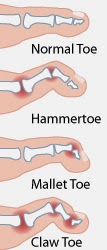
This picture is from a site called our health network. com I think it is great to show what is going on with the different types of toe issues.
B.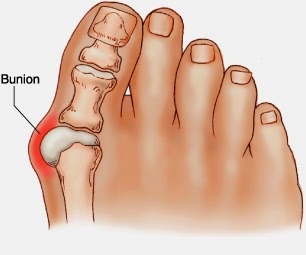
This picture is from a site called md guide lines. This condition can often be seen joining hammer toes.
Most of the toe issues I see are in Women. The main reason for this is our footwear. For the most part stylish shoes for women tend to be too pointy, too tight, high-heeled and sometimes too short. These conditions on a repeated basis cause pressure on the toes. Over time this pressure leads to toe muscle imbalance which leads to a pull and tension on the toe tendons. The longer the tendons are held under tension, they will become rigid and pull the toe joints out of alignment.
All of the conditions pictured above can start with poor, unhealthy footwear.
Another cause for Hammer toes is muscle imbalance starting in the low leg. When the calf muscles are overworked or over contracted and are not taken back to their normal resting length, the tendons of these muscles are placed under tension. The low leg muscle tendons end on the bones of the foot and toes. As these tendons pull the joints out of alignment and inflammatory process can occur. This process can then lead to Arthritis. Once Arthritis is on the scene we have a revolving door where one issue contributes to the other.
Finally, some people are prone to Hammer toes because their DNA sets them up for weaker or unstable structural support. A couple of examples would be flat feet or high arches. These conditions do not present by themselves, they usual arise from a postural deformity. The combination of the unstable structural support and muscle imbalances that follow lead to what has been described above.
What is going on exactly with the joints to show up as what we call Hammer toes?
C.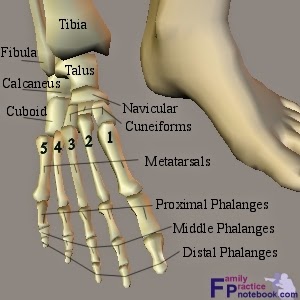
We can see the placement of the phalanges (Toe bones) in this great picture from fp notebook.
In a Hammer toe the metatarsal bone has bent down toward the floor shortening the tendon which causes the middle phalanges to raise up (refer back to picture A). A side effect of this joint raise is some degree of skin blister, callus or corn.
Claw toes like Hammer toes are the result of muscle imbalances, leading to ligament and tendon tension which leads to the mis-alignment of the toe joints. Again as with Hammer toes, this condition can have a revolving door occurrence with Arthritis.
What sets a Claw tow apart from a Hammer is the affect joint position. It is believed that Claw toes are never seen affecting the Big toe. In a claw tow, again, the metatarsal bones are bent down toward the floor. However, now the middle and distal phalanges raise up.
One will most likely see a Mallet toe in the second toe, as this toe tends to be the longs toe on many feet. Like the other two, the issue starts with the metatarsal bending down toward the floor. However, the only joint affected here is the distal phalanges.
Now what is happening with the accompanying Bunion often seen with Hammer toes?
Take a look at picture B. What you are seeing is the Big toe bone being pushed toward the first toe. Sometimes the Big toe can be pushed over or under the first toe depending on the degree and angle of pressure. The longer pressure is applied to the Big toe bones, gradually the metatarsal bone will migrate lateral (to the outside).
D. 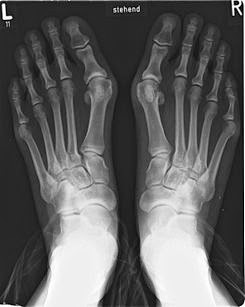
This is nicely shown in this picture from wikipedia.
Over time, if left in this condition, the lateral (outer edge) of either or both of the lateral head of the metatarsal or lateral aspect of the distal head of the proximal phalanges can develop an over growth (thickening) of bone or tissue. For the most part the larger bump that is seen is the normal anatomy of the head of the metatarsal. The area often being tender to touch, red and swollen is the bursal sac at the joint junction. If the pinky toe is affect it is termed a bunionette.
It is interesting to note, people who live in cultures where they go barefoot all the time, lack signs of bunions. This would suggest that the major cause of bunions is ill fitting shoes.
I believe with early detection all of these conditions can be prevented or at least supported in a fashion in which they remain mild, do not lead to more issues and do not require surgical correction.
Even if you have had one or more of these conditions for a while we can help to stop its progress and provide better out comes if surgery is believed necessary.
How can massage help these conditions?
1. we can locate the source of a postural issue and help to bring awareness and hopefully correction.
2. we can help to re-align muscles to help correct the muscle imbalances which in turn can alleviate the tension on the ligaments and tendons
3. with paraffin treatments we can help to bring new blood and oxygen to the ligament and tendons which in turn will help regain their flexibility and thus allow the joints to move back into proper alignment with time.
What will you need to do to help your massage process be its most effective?
1. be willing to wear healthier shoes
ones that have wider toe boxes, are flat and the proper size
2. speak to your MD regarding splints or other corrective devices
3. become aware of your posture and work to alter it to help balance your muscles
As always discuss your issues and how to treat them with your MD. So that you can go into your MD with more information check out healthyfeetstore.com to find great ideas for sandals, socks, shoes and devices. For a jumping off point google Correct Toes. For more support google Yoga Toes.
These are just a few ideas which with team work can help achieve healthy, pain free, sandal friendly feet.
For an appointment to plan for massage ways to address your foot issues visit :
