When you are a massage therapist you deal with attempting to define and manage pain. My trip to Thailand gave me pause for thought regarding pain. Massage there is not just something you do, it is a way of life. A big part of life and massage for the Thai people is visiting the Monks. As I set listening to the Monks talk about mediation and the goal not being to avoid pain but to acknowledge the areas of pain, I realized my mediation practice was faulty. They would tell us, rather than pretending there is no pain and trying to go to your zen place, say my knee hurts, if your knee hurts. They said repeat it over and over " my knee hurts, my knee hurts". The Monks explained it was the act of finding, acknowledging and speaking to the pain that allowed the pain to leave and for the mind to be freed.
For most of us in my Thai study group our first couple of massages in Thailand were extremely painful. We didn't speak the language and many of the therapist we sought treatment from outside of class had limited English skills. Often when we asked for a lighter touch they would smile and keep going. Over the three weeks our bodies changed or maybe our minds changed because we stopped complaining of pain. I wonder to this day, if part of the Thai therapist method came from their Buddhist understanding of pain. After sitting with the Monks I thought maybe the therapist were trying to help us meet our pain to facilitate its release.
My Thai massage pain adventure also speaks to the fact that pain is subjective. Pain varies from culture, person, place and time. You know if you are in a hurry you can hit something, experience pain and keep going. In the moment you forget about the pain, only days later to see a bruise and wonder how you got it. You could be having the worst, most stressful week at work and feel every thing causes you pain in every part of your body. If pain was simple it would be the same for all people and would occur exactly the same for each instance it occurred to you. However, pain is far from simple.
One of my mentors Tom Meyers was interviewed and his clip regarding pain is on YouTube. Here's the link
"Why Does Massage Hurt"
I like how he laid out three types of pain. The pain we put into a body, the pain we store and the pain we release. I try, as best I can, not to put new pain into a body while I massage. My hope is to help a person release their stored pain. When one experiences a lessening of pain with each stroke, I believe it's the body releasing stored pain with each stroke.
If you are seeking to re-align your body and wait to have massage until you feel pain then we can't start the re-alignment until we get you out of pain. The real work of massage occurs once the pain is gone. When the mind stops trying to remove the body from feeling pain we can then find the source of the body's dysfunction, misalignment and begin to create change.
Pain is a complicated experience and it is something that is bigger than just a physical body issue. However, I won't go all woowoo on you in this post :)
I will say, I would like to start a revolution, in which people seek massage before they are in pain so we can create change in a gentler environment. I'm so proud of all my regular clients because they stay ahead of their pain. They use their massage time to try and stay out of pain. Yes, there are sessions in which we still hit stored areas of pain and they experience moments of pain release put it happens more as those "pain feels so good " moments, than the "I'm going to jump off the table" moments. With each massage that occurs on my table I seek to help my clients connect deeper and deeper with their body. We work as a team to learn the silent language their body speaks, in hopes that we don't have to hear it scream at us in the universal language of pain.
Pain is our body's way of making us slow down or stop. It serves as a pointer to areas in need of help.
When it comes to the medical world pain is put into classifications. Most of us are familiar with attempting to discuss acute vs. chronic pain. For the most part we can attribute acute pain to an injury, illness, trauma or damage we can immediately identify and associate. Chronic pain we attribute to issues we can no longer identify where its coming from and it is something we deal with on a regular and lasting basis.
The medical world also classifies pain on three other levels:
Say you burn yourself, cut yourself you have caused tissue damage and it can for the most part be repaired. This is referred to as nociceptive pain.
Now you cut deep into your hand and sever a nerve and the feeling in your hand changes. This will be known as neuropathic pain.
If the doctors can not identify the source of your pain as either coming from tissue or nerve damage, well then, they will say you have psychogenic pain. The pain is coming from fear, depression or another mood.
Over the years I have found many pain sensations that are linked to chronic issues are largely coming from fascial sources. If someone tells me they are feeling a burning sensation, a weird itching sensation or an annoying stabling sensation, I'm going to work to warm, soften and redirect the fascia. When the fascia is hydrated and able to move in its fluid state that's when we achieve a pain release that seems immediate and the client says things like "it's a miracle" or "you have magic hands". Once the fascia is taken care of, often the muscles go along for the ride and the area no longer has an issue. Then the next step is to investigate what dehydrated the fascia in the first place. Now we identify posture and behavior that is contributing to dysfunctional movement.
Another complicated experience to convey is the increase in pain as we re-align areas of the body. When we are seeking structural re-alignment, muscle balancing, postural correction and the alteration of dysfunctional patterning we can create a short term increase in pain. The reason being, we are asking areas/muscles which have not been working properly, which are weak and often over stretched to now work. We are loosen over contracted/tight muscles and can't tone the week muscles fast enough and the body then has no support at all and muscles spasm as they are asked to quickly stabilize an unsupported joint. During the massage we stimulate nerves which is a way of toning muscles. However, once the client leaves the table they are not consist or misunderstand how to tone the muscles on their own and the body begins to slip back into a default mode, some areas remain unstable, others have a tug a war between the old and new states of being. All of this can create pain.
Massaging muscles, specially when a therapeutic massage session is requested, can produce a similar response to high intensity exercise in which the muscle fibers are broken down and have to go through an inflammatory stage of healing.This is typically experienced 24 to 48 hours following the massage. Then the third day the body feels better than it has in months.
The body is largely an electrical conductor. Electricity is conducted more efficiently in water. To improve the electrical communication in your body it is important to hydrate your fascia. When the fascia lacks proper fluid flow then areas stagnate and the nerve impulses in the area begin to slow down. If left long enough the area begins to have a tingling sensation then a numbing sensation and if left too long there can be irreversible nerve damage. As we begin to hydrate an area of fascia we reopen the body's ability to send nerve impulse in and out of the area. Due to cellular memory some times the re-awakened area fire out the old stored pain. But as one has forgotten about the original incident, it is believed the massage must have created new pain. The massage in a sense creates the pain by pulling it to the surface and activating the nerves in the area to send pain signals to the brain. This is more a release of pain that introducing new pain.
Now if we massage too fast, too deep or beyond the tolerance of the brain then yes massage can introduce new pain. This is why it is best to go slow and allow the body to invite the therapist's hand into deeper layers of tissue gradually and back off if the brain is feeling it as too much. Like Tom Meyers said the "no pain, no gain" attitude is not a go to method on the massage table because if at all possible one does not want to introduce new pain pathways the body now has to draw away from.
For those of you who know me and work with me regularly, you guys know what my take home message will be right? To decrease the experience of pain address your fascia. Drink water consistently through out your day. Get that water into your tissue by Dry Brushing and/or Melting first on a weekly basis and then as needed. Create practices which allow you to enter and maintain a state of parasympathetic being more often then remaining in a high constant state of sympathetic nervous system chaos. Working to ensure your diaphragm is working as the primary respiratory muscle it was born to be rather than a major stabilizer is one way to create a better state of parasympathetic being. Finding time to include rest not only for your body but for your mind will greatly enhance tissue and muscle health. Developing a means to address and maneuver between all four of your bodies; physical, emotional, mental and spiritual will help you understand how to achieve homeostasis; which I believe is a truer state of well-being than seeking to maintain balance.
If you have any questions regarding this post or you would like me to write in more detail about any aspect of this post, please feel free to comment in the comment section or email me (2dolphincolette@comcast.net)
As always thank you so much for taking the time to read my posts.

Colette-Eclectic Healing Guide is connected to: www.colette.massagetherapy.com FaceBook @Eclectichealingguide and Instagram @eclectichealingguide. All information in this Blog is for Educational purposes only! Please Consult your Health Care Provider concerning any disease or injury. The author is Not recommending that you self-diagnose or self-prescribe. Please discuss with your Health Care Provider before introducing anything new to your wellness routine.
Showing posts with label massage. Show all posts
Showing posts with label massage. Show all posts
Friday, July 29, 2016

Wednesday, July 20, 2016

Sunday, July 17, 2016
Can you benefit from Craniosacral Therapy
Craniosacral Massage
is a subtle form of bodywork in which the therapist works with the subtle third rhythm of the body that falls beneath the breath and the heartbeat. The therapist uses gentle holding, compression like hand positions to stimulate the client’s natural internal healing abilities. As the cerebral spinal fluid rhythm re-balances the skull bones are allowed to re-align, connective tissue unwinds and re-alignment within the connection of the cranium, spine and sacrum occur. Clients wear loose comfortable clothing and remain fully clothed throughout the session. Clients are on their back for the entire session. Hugely relaxing with clients often falling to sleep, this form of bodywork has been helpful reducing symptoms related to ADHD, migraines, TMJ and Chronic pain. It is also helpful when preparing to become pregnant and following child birth.

Tuesday, July 12, 2016
Little insight into Thai Massage
Thai Massage
can be thought of as passive yoga for the client and active yoga for the therapist. It is an Eastern form of bodywork incorporating meridian stimulation (known as Sen lines), compression, abdominal massage, tapotement and emphasizing stretching. For the most benefit the therapist structures a routine to fit the client's needs and the balance between the client and practitioner. The client wears loose, comfortable clothing and remains clothed throughout the session. This massage takes place on a mat on the floor. Working on the floor allows the therapist to maximize leverage and increases the stretching benefits. Thai massage improves the flow of energy throughout the body, increasing vitality, flexibility and muscle tone. A traditional Thai massage has a minimal duration of one and one half hours.
Monday, June 6, 2016
Ice vs Heat Dilemma
People always ask which is better when it comes to sore muscles and soft tissue injuries, Ice or Heat.
Before a good answer can be given we must first understand what inflammation is and how it works with the body.
A basic definition of inflammation is the appearance of Heat, Redness, Swelling and Pain in and around an area of the body.
Inflammation is our body's response to disease, illness, infection or trauma. It is part of the body's immune system's first line of defense. When the body detects a foreign invader/substance or trauma it begins a chemical reaction. The resulting substances from the White Blood Cells are rushed to the site through an increase in blood flow. This increase in blood flow is seen and felt as heat and redness. Due to the rapid increase of the volume of immune substances in one area fluid can leak into the surrounding spaces which is then noted as swelling. The expansion of tissue and the response to this tension on the surrounding tissue can activate local nerves to transmit a pain response. As long as this event is short term/acute the process is reparative. In the short term inflammation helps an injured area by increasing oxygen, proteins and other nutrients, destroying pathogens and toxins, and delivering repair materials and molecules.
In general there are 3 phases of healing. Inflammation which can take between 1-3 days. Then Proliferation occurs which is the process of repair and requires a sufficient and proper supply of oxygen, nutrients and fibroblast. Finally is the Maturation phase which happens once the surface of the wound is closed.
The immediate response in the inflammatory phase is a contraction of the damaged area's blood vessels to prevent an excessive amount of blood loss. When the area switches to active inflammation the blood vessels dilate. Vessel dilation helps to increase the flow of blood and increase the level of oxygen and nutrients.
However, if inflammation goes on past 3 days it then is considered chronic and could then become damaging to the process of healing. The key factors in an area remaining in a state of healthy repair vs unhealthy is the degree and duration of blood vessel dilation, degree of permeability of blood vessels to properly regulate the amount and type of fluid, proteins, leukocytes into the healing area. For a healthy repair response blood vessel dilation should begin within 30 mins after the initial constriction of the blood vessels and the closure of the wound.
The main factor when determining when to use ice vs heat comes from the timing of the area requiring the blood vessels to be in a state of constriction vs dilation. If the blood vessels remain constricted for too long then the delivery of oxygen, nutrients and fibroblast is delayed and healing is thus delayed. However, blood vessels constriction does reduce or eliminate the experience of pain by inhibiting the communication of nerve impulses in the affected area. Sometimes it is necessary to initially inhibit the transmission of pain in order for the brain to allow the person to begin to calm down and thus direct the energy toward repair rather than defense.
For many years the Gold Standard was set by Dr. Gabe Mirkin who developed the concept of RICE= Rest, Ice, Compression and Elevation. Due to the surfacing of new research Dr.Mirkin has now begun to alter his stance on ice. The key factor in the change came with the discovery that the macrophases (part of the immune cascade) produce as substance called Insulin-like Growth Factor (IGF-1) which is the determining hormone for healing. The presence of this factor is required for both wound healing and muscle/soft tissue damage.
When discussing soft tissue or muscle issues/damage, I believe we must now be considering whether the area is experiencing fascial dehydration rather than blood vessel damage or fiber damage. We would start by learning if there was a direct incident of trauma i.e. cut, hit or fall that could have resulted in broken bones or damaged tissue. With a lack of contact trauma we then ask for an indication of tissue damage such as sign of broken blood vessels, bruising, redness, swelling or heat. If none of those signs and symptoms are reported but rather the person speaks of being unable to pin point the pain, there being a sensation of burning or pulling or a sharp stabbing pain that comes and goes and if these symptoms come following a minor task such as bending over to pick up a towel, repetitive motion tasks or after extreme exercise then we more then likely are dealing with a circumstance of fascial dehydration.
Ice is a tricky substance to use when treating the body because just like inflammation or any other beneficial thing too much of a good thing can lead to trouble. Ice is also tricky when used on an area which has signs of inflammation because the indications ice has been left on an area too long is redness, swelling, tingling and pain. See the problem? We usually know the negative affects of prolonged cold as an area turning blue, purple or black. These are extreme signs and if you see these it is too late. The other more settle sign is a white appears with a surface hardness. Again you don't want to get to this stage because that means you will lose the surface tissue due to cell death.
Alrighty, so you are now probably saying OK Colette get with it and tells us when and how we should use ice.
In general, if you are experiencing pain and you feel called to use ice, I would recommend using an ice cube and gentle rubbing it over the painful area. As the ice begins to melt stop and pat the area dry. This gives you a chance to determine if the pain is beginning to decrease. I would not do more that three passes and no longer than 10 mins total of ice in one area. If the area is too big or you are not able to reach it to move the ice cube then use an ice pack, bag or strap but only allowing it to remain in any one area for no longer than 10 mins and staying closer to 5 mins or less is ideal. By doing this you will be able to reduce pain, start taking the nervous system into a parasympathetic state which will calm the body and remain within the optimal time frame for the initiation of vessel dilation and the production of IGF-1.
If there is no pain then it is best to avoid ice!
New research involving the recovery time and performance of athletes now also offers more reasons to avoid ice. These studies show ice can reduce an athlete's strengthen, speed, coordination and endurance. In my opinion we must again consider fascia. When we understand fascia is in every cell of the body, it runs through muscles fibers and it has 10 times more nerve ending in it than muscles carry; it makes sense that if the vessels flowing through it are constricted, then it will become dehydrated and without fluid there is less nerve communication. Less nerve communication means there will be a decrease in the sensation of strengthen, there will be a delay in motor response leading to a decrease in speed, there will be miscommunication from one area to another resulting in poor coordination and finally with nerve inhibition there will be muscle fatigue which means a decrease in stamina or endurance.
Ligaments and tendons are a form of fascial tissue and they have less blood vessels than muscles. The limited number of blood vessels makes these tissues prone to delayed healing when compared to muscles and other soft tissue injuries. From what you now know about ice you see that icing these tissue will only decrease an already compromised state of wound repair.
When looking at duration of ice application we must bring our attention to research as far back as the 1980s that revealed the body will remain cold for several hours following stagnate ice of only 20 mins. When the body remains cold for this long the nerves again will decrease in conduction and can lead to permanent damage with the appearance of nerve palsies. However, if after icing, the area is rewarmed soon enough the risk of damage is greatly reduced, if not eliminated all together. This then speaks to the benefit of contrast thermal therapy. One can either accomplish this through a contrast shower or topical application in which one alternates cold, hot, cold, hot. If there were pain one would start with hot, cold, hot, end hot. If there was swelling one would start with cold, hot, cold, end on cold. In either case you would only apply the cold for no more than 10 mins.
Now for heat. You want to avoid heat where you see acute inflammation. If there is already an increase in blood flow, redness, and swelling you do not need heat. Heat will only further dilate blood vessels and increase the inflammatory response.
Warm moist heat is the best when it comes to tissue repair. Using a hot water bottle, whirl pool or hot tub are the best options to providing a soothing environment to stimulate the rehydration of fascia and the relaxation of contracted muscles. Water conducts heat better than air, with better conduction the heat is retained longer and can penetrate deeper into the muscle layers. The heat then is mimicking the inflammatory process of dilating blood vessels which increases blood flow and the delivery of oxygen and nutrients which allow the muscle to recover faster. Dry heat such as from an electric heating pad can actually dry out the skin. Dry skin leads to dehydrated fascia, dehydrated fascia leads to pain. The best results are to apply the moist heat for no longer than 30 mins at any given time.
In conclusion, when trying to decide between ice and heat your choice will depend on how much you can tolerate pain and if there is swelling present. To achieve the best and longest lasting healing results and performance when it comes to sports, avoid ice unless there is pain or swelling. In those cases do not use ice for longer than 10 mins and if possible alternate ice with moist heat. Moist heat is your best options when it comes to general, chronic muscle tension.
I hope you were introduced to new information and you find this information helpful.
Remember, I always advise you see a doctor if you suspect you have injured yourself so we know for sure if there is any bone damage or other serve tissue damage.
www.colette.massagetherapy.com
Monday, November 9, 2015
Are You Missing Your Core
All you have to do is ask google what your core is and the images you will see will be something like this
 (Picture from Anatomy Altas)
Heavy on the Abdominal muscles. You'll see a lot of photos of bulging 6 packs. You will be given exercises focused on getting every muscle in your abdominal cavity rock hard. If your core is made up of all these "stomach" muscles then why are we still so unstable? What are we missing when it comes to strengtheing our core?
What we and most trainers are overlooking is the Diaphragm!
By definition a Core is the central, most important part of something.
Researchers in recent years are putting out more and more information showing how the diaphragm is linked to just about every major system that keeps us alive. One of the biggest systems supported by the diaphragm is the body's Respiratory functions. As a person would die without being able to breath why have we ignored the diaphragm for so long? Maybe because it isn't out in front showing off like the Rectus Abdominis (pictured above) better known as the stomach's 6 pack.
When asked what is the primary muscle of respiration, I bet you wouldn't say the diaphragm. After reading to the end I'm sure you will now.
The diaphragm is so much more than just the primary muscle of respiration. It is one of our most complex muscles.
However, here I'm going to try not to get us lost in the complexity but rather try to reveal it's importance and wide reaching connection to other parts of the body.
In simple terms we can say the diaphragm is composed of muscle, tendentious and fascial material. It is connected to the lower 6 ribs, the sternum, the spinal vertebrae, the Transersus Abdominis muscle and the Psoas muscle. It is part of the information super highway with various important nerves passing through it. Via its neuronal connections it is associated with the functioning of the TMJ, floor of the mouth and the pelvic floor. Its contraction and connection to the thoracic duct makes it the main facilitator of the lymph fluid being delivered to its final destination within the heart. It helps regulate oxygen and carbon dioxide levels. Finally it helps to regulate stress. Are we starting to understand why it is truly the body's core?
Since the diaphragm has be hidden and misunderstood for so long many of us are walking around with a dysfunctional core. You might be amazed how many of your aches and pains are probably due to this dysfunction.
What are some signs your diaphragm is offline and not functioning properly?
Ways to help get your diaphragm back online, enhance your posture and improve your breathing
Now let's play around with some techniques to help activate your diaphragm and enhance your breathing.
1. Extending your exhale:
into your hands, exhale through your mouth and feel your ribs drop toward your hips and make less contact with your hands. Repeat three times
3. Modified circular breathin
* Place your tongue to the roof of your mouth, inhale through your nose, pause, release your tongue, slowly drop open your jaw while exhaling through the mouth
One of the cutting edge information providers is the Postural Restoration Institute. From their site I have learned of the benefits of balloon breathing and the 90-90 hip lift balloon breath. The later is a pretty advanced technique, therefore I recommend you start with everything above building up to the full 90-90. You may also want to come in for help to make sure you are using proper form.
Variation one:
1. Hold a balloon to your mouth with your left hand
put your tongue to the roof of your mouth
inhale through your nose
pause and release your tongue
exhale into the balloon for a count of 4
clamp the balloon closed with your left fingers,
pause for a count of 4
repeat : starting with the inhale through the nose
You'll do 4 breaths in through the nose and
3 breaths exhaled into the balloon with the 4th out
breath without the balloon

Variation Two:
Variation Three:
3. Combine 1 and 2
Arm variations for #3
a. Do 3 with arm variation of right arm extended flat on surface next to the ear with straight elbow
b. Do 3 with arm variation of right arm extended next to ear and raised into the air
Now that you have looked at the signs you have not been using your diaphragm properly and you have an idea of how to start addressing and changing your diaphragm's functioning you might be interested in more details.
Let's really get to know the diaphragm. It looks similar to a parachute. It is dome shaped with the exterior being skeletal muscle and the interior being fascia (connective tissue). It is higher, thicker and stronger on the right side of the body than the left . The higher position on the right is due to the internal organs making space for the big shot, the Heart, on the left side of the body. It separates the upper part of the body (or thoracic cavity) holding up the heart and lungs from the lower part of the body (or abdominal cavity) surrounding the liver, gall bladder, spleen and stomach. It has fascia (connective tissue) that attaches to the back side of the sternum on both the right and left at the Xiphod process. 6 of its fascial threads attach to the lower 6 ribs (ribs 7-12) on both the right and left sides. Remembering there is an inner and outer component to the diaphragm therefore there is also fascial threads extending to the upper right border of the 5th rib and the lower left border of the 5th rib. At the back of the body it has threads attaching on the right side to the first three lumbar vertebrae and their intervertebral discs and on the left side to the first two lumbar vertebrae. Coming from the sides of the body going down toward the feet its fascia thickens and joins with the front portion of the psoas muscle and joins with the upper portion of the back muscle the quadratus lumborum. There is also a fascial connection into the transverse abdominal muscles. The diaphragm also has three major and several minor opening to allow the esophagus, vena cava, aorta and nerves and blood vessels to pass from the chest cavity to the abdominal cavity and vice versa.

The shape of the diaphragm changes as it works and depends on what and how the rib muscles are working. The ideal method of breathing requires us to work the respiratory system in 3 dimensions. With need to be able to move vertically (from the hips to the clavicle and back down) , horizontally (moving the rib cage out to the arms and back in) and front to back (to the spine and away from it). How does this ideally happen? When you inhale the diaphragm is contracted, its central fascia is pulled down toward the feet which increases the vertical diameter of the chest allowing the lungs to expand and air to enter. At the same time the accessory breathing muscles, the muscles between the ribs pull the ribs up and out. As you exhale the diaphragm relaxes and folds in on itself pushing up on the lungs and the rib muscles pull the ribs in and down which pushes air out of the lungs. Due to the diaphragm's attachment into the spine the chest cavity also pulls away from the spine and in toward the spine to push air in and out.

It's the diaphragm's relationship to the ribs and pelvic floor ( via the fascial connections to the psoas, quadratus lumborum and transverse abdominals) or the amount of contact between them which creates the true body core. The technical term for this contact is the Zone of Apposition (ZOA). The core stability comes from your diaphragm being able to achieve a balance of pressure within the chest cavity and the abdominal cavity.When we have a balance of thoracic and abdominal pressure we stabilize our spine due to the diaphragm's fascial connections to the spine. This ideal is rarely achieved by most people. Most people are heavily relaying on their accessory rib muscles, the neck muscles connecting to the ribs (scalenes) and the pectoral muscles (chest muscles). The utilization of these muscles create what is known as a chest breather. The longer we chest breathe the more slack we place on the diaphragm. This slack in turn translates to a laxity of the abdominal contents the small intestines begin to slump down and forward. In an attempt to compensate the pelvis begins to tilt either too far forward or backward.

How does this loss of diaphragm power and chest breathing create more problems for the over all functioning of the body? As the intercostal muscles (rib cage muscles) and the chest muscles take over the lungs begin to get less and less space. This also happens when the body is placed in a dangerous situation. When we are in danger our fight or flight response kicks in and we recruit muscles which use less energy. In this situation our bodies release stress hormones like cortisol, adrenaline and norepinephrine. The unfortunate thing for our health is the brain doesn't know the difference between chest breathing due to poor posture verses our body being in danger and consequently the brain signals stress hormones for both situations. Therefore, continual chest breathing equals continual low grade stress response. Now we are in a vicious cycle of dysfunctional breathing causing a stress response and the stress response causing tension on the muscles.To break this cycle practice the 11 tips above to retrain your brain and get your diaphragm back online.

This final picture shows a very simplified take on how we breath. It also shows that if we are heavily focusing on the abdominal muscles we are primarily utilizing one directional breaths.
We want to keep remembering 3 dimensional breathing. Our goal is not to replace chest breathing with abdominal breathing but rather to lead with diaphragmatic breathing that incorporates all the respiratory muscles as well as establishing proper functional thoracic and abdominal pressure.
Want a little jump start to your diaphragm rehabilitation program?
Come on in for a massage. We can use manual manipulation of the rib cage to loosen the intercostal muscles; abdominal massage to help soften the fascia of the stomach which will help to release the diaphragm. Massaging the psoas and quadratus muscle to address the imbalance of the pelvic girdle and improve the abdominal tension. Addressing any held tension in the jaw muscles to help break the stress hormone cycle. If this all sounds good, don't wait to put your self care first, Book Your Massage Now.
Click here:
http://eclectichealingguide.fullslate.com/
Heavy on the Abdominal muscles. You'll see a lot of photos of bulging 6 packs. You will be given exercises focused on getting every muscle in your abdominal cavity rock hard. If your core is made up of all these "stomach" muscles then why are we still so unstable? What are we missing when it comes to strengtheing our core?
What we and most trainers are overlooking is the Diaphragm!
By definition a Core is the central, most important part of something.
Researchers in recent years are putting out more and more information showing how the diaphragm is linked to just about every major system that keeps us alive. One of the biggest systems supported by the diaphragm is the body's Respiratory functions. As a person would die without being able to breath why have we ignored the diaphragm for so long? Maybe because it isn't out in front showing off like the Rectus Abdominis (pictured above) better known as the stomach's 6 pack.
When asked what is the primary muscle of respiration, I bet you wouldn't say the diaphragm. After reading to the end I'm sure you will now.
The diaphragm is so much more than just the primary muscle of respiration. It is one of our most complex muscles.
However, here I'm going to try not to get us lost in the complexity but rather try to reveal it's importance and wide reaching connection to other parts of the body.
In simple terms we can say the diaphragm is composed of muscle, tendentious and fascial material. It is connected to the lower 6 ribs, the sternum, the spinal vertebrae, the Transersus Abdominis muscle and the Psoas muscle. It is part of the information super highway with various important nerves passing through it. Via its neuronal connections it is associated with the functioning of the TMJ, floor of the mouth and the pelvic floor. Its contraction and connection to the thoracic duct makes it the main facilitator of the lymph fluid being delivered to its final destination within the heart. It helps regulate oxygen and carbon dioxide levels. Finally it helps to regulate stress. Are we starting to understand why it is truly the body's core?
Since the diaphragm has be hidden and misunderstood for so long many of us are walking around with a dysfunctional core. You might be amazed how many of your aches and pains are probably due to this dysfunction.
What are some signs your diaphragm is offline and not functioning properly?
- Your lower stomach extends down and past your hip bones while your low back sways/curves
- Your upper stomach appears sunken under your lower ribs and your chest appears puffed out
- When you raise your arms to your ears your elbows bend outward
- Your head tilts excessively forward
- You suck your stomach in when you inhale a breath
- You raise your shoulders as you inhale
- You push your upper chest forward as you inhale
- You have chronic rib pain and/or need regular rib adjustments
- You have chronic horizontal mid back pain
- You breath through your mouth when resting
- You have to take frequent deep breaths with a sigh and/or yawn
- You have or had a hiatal and/or inguinal hernia
Ways to help get your diaphragm back online, enhance your posture and improve your breathing
- Soften and stretch the fascia of your abdomen
- Stop trying to create rock hard abdominal muscles
- Stretch your quadratus muscles
- Strengthen your hamstrings and lower glutes
- Stretch the pectoral muscles
- Stretch the psoas muscles
- Begin to do more with your left hand
- Intentionally walk making sure to move opposing limbs i.e. take your first step with your left foot while swinging your right arm forward and then your right foot with your left arm.
- Go back to crawling like a baby at least once a week. Here again use an opposing limb movement.
- Stretch and soften your jaw muscles
- Practice extending your exhale
Now let's play around with some techniques to help activate your diaphragm and enhance your breathing.
1. Extending your exhale:
- Either start by laying on your back or standing ( you want to make sure there is no bending around the bottom ribs if possible) now inhale for a count of 1, hold for 1 and exhale for your goal is to reach an 8 count
- Try exhaling with a candle : sit in front of a candle, create a circle with your lips (like you are going to breath through a straw), now breath slowing and gentle into the candle trying to make it flicker but not extinguishing the flame.
2. Connecting with the sides of your body. Lateral rib expansion:
* Place your hands on the sides of your ribs, inhale through your nose while expanding your ribsinto your hands, exhale through your mouth and feel your ribs drop toward your hips and make less contact with your hands. Repeat three times
3. Modified circular breathin
* Place your tongue to the roof of your mouth, inhale through your nose, pause, release your tongue, slowly drop open your jaw while exhaling through the mouth
One of the cutting edge information providers is the Postural Restoration Institute. From their site I have learned of the benefits of balloon breathing and the 90-90 hip lift balloon breath. The later is a pretty advanced technique, therefore I recommend you start with everything above building up to the full 90-90. You may also want to come in for help to make sure you are using proper form.
Variation one:
1. Hold a balloon to your mouth with your left hand
put your tongue to the roof of your mouth
inhale through your nose
pause and release your tongue
exhale into the balloon for a count of 4
clamp the balloon closed with your left fingers,
pause for a count of 4
repeat : starting with the inhale through the nose
You'll do 4 breaths in through the nose and
3 breaths exhaled into the balloon with the 4th out
breath without the balloon

Variation Two:
2. Lay on your back with your feet flat, shoulder width apart and touching a wall
(don't push into the wall)
put a ball or something between your knees
keep your stomach soft throughout
using your hamstrings lift your pelvis off the ground
while keeping your back flat on the ground
make sure not to press your feet into the wall
repeat 4 times
3. Combine 1 and 2
Lay on your back with feet flat, shoulder width apart and touching a wall
put a ball or something between your knees
keep stomach soft
lift the pelvis with your hamstrings
hold a balloon to your mouth with left hand
put your tongue to the roof of your mouth inhale through your nose
release the tongue and exhale into the balloon
clamp off the balloon with the fingers and count to 4
keep the pelvis lifted
repeat the breaths with a total of 4 inhales, 3 exhales into balloon
and 1 exhale out of mouth without the balloon
through out the right arm is by your side with hand palm up
a. Do 3 with arm variation of right arm extended flat on surface next to the ear with straight elbow
b. Do 3 with arm variation of right arm extended next to ear and raised into the air
Now that you have looked at the signs you have not been using your diaphragm properly and you have an idea of how to start addressing and changing your diaphragm's functioning you might be interested in more details.
The shape of the diaphragm changes as it works and depends on what and how the rib muscles are working. The ideal method of breathing requires us to work the respiratory system in 3 dimensions. With need to be able to move vertically (from the hips to the clavicle and back down) , horizontally (moving the rib cage out to the arms and back in) and front to back (to the spine and away from it). How does this ideally happen? When you inhale the diaphragm is contracted, its central fascia is pulled down toward the feet which increases the vertical diameter of the chest allowing the lungs to expand and air to enter. At the same time the accessory breathing muscles, the muscles between the ribs pull the ribs up and out. As you exhale the diaphragm relaxes and folds in on itself pushing up on the lungs and the rib muscles pull the ribs in and down which pushes air out of the lungs. Due to the diaphragm's attachment into the spine the chest cavity also pulls away from the spine and in toward the spine to push air in and out.
It's the diaphragm's relationship to the ribs and pelvic floor ( via the fascial connections to the psoas, quadratus lumborum and transverse abdominals) or the amount of contact between them which creates the true body core. The technical term for this contact is the Zone of Apposition (ZOA). The core stability comes from your diaphragm being able to achieve a balance of pressure within the chest cavity and the abdominal cavity.When we have a balance of thoracic and abdominal pressure we stabilize our spine due to the diaphragm's fascial connections to the spine. This ideal is rarely achieved by most people. Most people are heavily relaying on their accessory rib muscles, the neck muscles connecting to the ribs (scalenes) and the pectoral muscles (chest muscles). The utilization of these muscles create what is known as a chest breather. The longer we chest breathe the more slack we place on the diaphragm. This slack in turn translates to a laxity of the abdominal contents the small intestines begin to slump down and forward. In an attempt to compensate the pelvis begins to tilt either too far forward or backward.
How does this loss of diaphragm power and chest breathing create more problems for the over all functioning of the body? As the intercostal muscles (rib cage muscles) and the chest muscles take over the lungs begin to get less and less space. This also happens when the body is placed in a dangerous situation. When we are in danger our fight or flight response kicks in and we recruit muscles which use less energy. In this situation our bodies release stress hormones like cortisol, adrenaline and norepinephrine. The unfortunate thing for our health is the brain doesn't know the difference between chest breathing due to poor posture verses our body being in danger and consequently the brain signals stress hormones for both situations. Therefore, continual chest breathing equals continual low grade stress response. Now we are in a vicious cycle of dysfunctional breathing causing a stress response and the stress response causing tension on the muscles.To break this cycle practice the 11 tips above to retrain your brain and get your diaphragm back online.
This final picture shows a very simplified take on how we breath. It also shows that if we are heavily focusing on the abdominal muscles we are primarily utilizing one directional breaths.
We want to keep remembering 3 dimensional breathing. Our goal is not to replace chest breathing with abdominal breathing but rather to lead with diaphragmatic breathing that incorporates all the respiratory muscles as well as establishing proper functional thoracic and abdominal pressure.
Want a little jump start to your diaphragm rehabilitation program?
Come on in for a massage. We can use manual manipulation of the rib cage to loosen the intercostal muscles; abdominal massage to help soften the fascia of the stomach which will help to release the diaphragm. Massaging the psoas and quadratus muscle to address the imbalance of the pelvic girdle and improve the abdominal tension. Addressing any held tension in the jaw muscles to help break the stress hormone cycle. If this all sounds good, don't wait to put your self care first, Book Your Massage Now.
http://eclectichealingguide.fullslate.com/
Thank you for reading.All pictures from the Anatomy Atlas. Except for my personal photo :)
Thursday, October 8, 2015
The Heart Rules Our Posture
Did you ever wonder why the world is dominated by all things right sided?
Start to look around at your fellow humans. You might begin to notice the right side dominance isn't just about people using their right hands. Oh no, it goes much deeper than the activity of the right hand.
The right side dominance largely develops out of the size and position of the heart. The heart itself is not symmetrical. It has 4 chambers, two atria and two ventricles; with the left ventricle being the largest of the chambers. These chambers create the body of the heart which is located mostly on the left of the body with a slight tilt to the right and behind the sternum. As it takes up a significant portion of the upper left compartment of the chest cavity the other organs develop around it asymmetrically.
Separated by the heart are the Lungs. Though there are two lungs they are not equal. The left lung only has two lobes to allow the heart to tuck within and slightly behind it. The right lung dominates the right side of the chest cavity with three lobes. Moving down to the feet we find the lungs contacting the parachute like diaphragm. Again because of the heart's position on the left the diaphragm has to extend higher on the right side of the body.
From the diaphragm we move down toward the feet again and into the abdominal cavity. Here the largest part to the liver is tucked up into the diaphragm on the right side of the body. There are four lobes to the liver with three on the right side and the smaller forth portion positioned behind the sternum and contacting the stomach to the left of the body.
Are you starting to get the picture? Because we value are heart so much we have heavily weighted the right side of our body to compensate for the room we've given the heart. For most of us this means we will lean to the right. Do some people watching. Ask your friends how many of them have problems on their right hips, legs, feet and left shoulders. The reason for this cross body phenomena is partially the heart's dominance and creation of the internal asymmetry of the internal organs.
Subconsciously, then, the world becomes built around this right side heaviness so to speak. Then we begin to favor our right hands and we further the asymmetrical repetitive habits.
We are given two arms and two legs with symmetry to compensate for the asymmetry created by the heart. We are ideally suppose to use our left arm and right leg (and visa verse) to move us forward. The heads of our femurs are suppose to move within the hip sockets like pistons (up and down and backward and forward). However for most of us we lack movement in the pelvic girdle and the femur heads move out of the sockets to the outside of the body before moving forward.
There are a few people out there who use both sides of their body equally and have not paid attention to the right side weight. Most of us are not that lucky and must start to bring more awareness to your left side. Play around with taking your first step with your left foot, reach for items with your left hand and pick things up with your left hand. This will begin to retrain your brain. See how long it takes your posture to change as you reprogram your brain with reciprocal movement.
In future posts I will discuss how to continue to reprogram the brain by addressing the Diaphragm's right side dominance. I believe when we understand the functioning of the diaphragm we begin to understand the body's true core is the diaphragm. This realization will revolutionize your postural awareness. Stay tuned....
Tuesday, September 1, 2015
The Palm of Christ upon the Stomach Part2
How Castor Oil Can Help with Constipation Issues
Let's start where my castor oil education began, with why the naturopaths used it for digestive issues. These holistic doctors were working with patients dealing with constipation. Though some holistic doctors will prescribe castor oil as an internal remedy, meaning they will have you ingest it by mouth, my education started with a topical method called a "castor oil pack".
Some older people may remember their grandparents giving them spoonfuls of castor oil as a child as a home remedy for stomach cramps and constipation before the popularity of the naturopathic profession. The FDA has determined it safe and effective for humans to use internally as a stimulate, laxative. However, some individuals who have consumed too much for extended periods of time have experienced unpleasant results. These unpleasant results were; diarreha, nausea, vomiting, fluid and electrolyte imbalances, abdominal cramping/pain and sever gas. These results have not been reported with external use of castor oil. Still, as with any treatment, one should be aware of any unusual symptoms that linger, stop the treatments and should inform one's doctor or health care provider.


In another post I will go into detail regarding how I combine Castor oil packs and Thai Abdominal Massage to help detox, tone and improve overall well- being of the Abdominal area and the body in general.
Let's start where my castor oil education began, with why the naturopaths used it for digestive issues. These holistic doctors were working with patients dealing with constipation. Though some holistic doctors will prescribe castor oil as an internal remedy, meaning they will have you ingest it by mouth, my education started with a topical method called a "castor oil pack".
Some older people may remember their grandparents giving them spoonfuls of castor oil as a child as a home remedy for stomach cramps and constipation before the popularity of the naturopathic profession. The FDA has determined it safe and effective for humans to use internally as a stimulate, laxative. However, some individuals who have consumed too much for extended periods of time have experienced unpleasant results. These unpleasant results were; diarreha, nausea, vomiting, fluid and electrolyte imbalances, abdominal cramping/pain and sever gas. These results have not been reported with external use of castor oil. Still, as with any treatment, one should be aware of any unusual symptoms that linger, stop the treatments and should inform one's doctor or health care provider.
This post will be dealing only with my education and knowledge of castor oils topical benefits and treatment.
During my time working for the naturopathic doctors I was trained to be a colonic therapist. Which meant I had to learn, among other things, what constitutes healthy bowel movements. How the bowels move depends on peristalsis ( the contraction and relaxation of the intestines). It is this alternation of muscle contraction and relaxation that moves the feces through the intestines into the colon and out. Besides the elimination of feces the movement of the bowels creates nutrient absorption. The nutrients are best absorbed when the nerves and muscles of the small and large intestines work together in a rhythmic manner. How often an individual moves their bowels depends on what they eat, how often they eat, the state of abdominal fascia, the state of neuromuscular communication and how frequently they allow themselves to have a movement. Typically we should be more like babies, eliminating approximately 1-2 hours after eating. However, with the introduction of working outside of the home and social graces, adults develop a habit of holding the bowels until they are in the privacy of their home. This holding habit is what starts the issue. The issue is first revealed when the individual finds the need to push or strain in order to move the bowels. Once this happens individuals may began to go less frequently. Now combine this habit of holding onto your bowels with stress and the common habit of not drinking enough water and you are on your way to constipation. If you throw in stagnation of the digestive track and tension in the abdominal muscles you have just added another layer to the problem.
During my time working for the naturopathic doctors I was trained to be a colonic therapist. Which meant I had to learn, among other things, what constitutes healthy bowel movements. How the bowels move depends on peristalsis ( the contraction and relaxation of the intestines). It is this alternation of muscle contraction and relaxation that moves the feces through the intestines into the colon and out. Besides the elimination of feces the movement of the bowels creates nutrient absorption. The nutrients are best absorbed when the nerves and muscles of the small and large intestines work together in a rhythmic manner. How often an individual moves their bowels depends on what they eat, how often they eat, the state of abdominal fascia, the state of neuromuscular communication and how frequently they allow themselves to have a movement. Typically we should be more like babies, eliminating approximately 1-2 hours after eating. However, with the introduction of working outside of the home and social graces, adults develop a habit of holding the bowels until they are in the privacy of their home. This holding habit is what starts the issue. The issue is first revealed when the individual finds the need to push or strain in order to move the bowels. Once this happens individuals may began to go less frequently. Now combine this habit of holding onto your bowels with stress and the common habit of not drinking enough water and you are on your way to constipation. If you throw in stagnation of the digestive track and tension in the abdominal muscles you have just added another layer to the problem.
What are the common signs of constipation:
1. Not eliminating at least once per day on a regular basis
2. Fecal matter appearing lumpy, hard or like little bunny pellets
3. Pushing, straining or taking longer than a couple minutes to poop ( the amount of time it takes to pee is the time it should take to poop)
4. Feeling bloated, heavy or the need to go again soon after a movement
Now let's look at what Castor Oil is and why it can help move the bowels and promote health. Castor oil is extracted from seeds of the castor plant (Ricinus Communis). It is classified as a vegetable oil. It's biology defines it as a triglyceride, monounsaturated 18 chain fatty acid. The component that sets it apart from other vegetable oils and makes it the miracle oil is Ricinoleic acid. It is also biodegradable.
Castor oil works on the small and large intestine. It is absorbed through the skin into the lining of the bowels. The oil works within the intestine without taking up any of the intestinal moisture (water). Castor oil lubricates the tracks and releases fecal matter moving it through the channel into the colon. It also stimulates circulation. The body always functions better when new blood and oxygen move through an area, allowing the area to receive nutrients and fluids for flow.
What will you need to place the Palm of Christ on your stomach and get your bowels to move more efficiently?
1. Castor oil
2. Wool flannel
3. Hot water bottle
4. large towel
What type of Castor oil:
What will you need to place the Palm of Christ on your stomach and get your bowels to move more efficiently?
1. Castor oil
2. Wool flannel
3. Hot water bottle
4. large towel
What type of Castor oil:
The appearance of the oil can vary. I find, the higher grade, 100% natural, organic, unrefined, cold pressed products sold in health food stores tend to have a darker, richer color and often have a bit of a woody smell. For added benefits I've been told to select the raw product. The bottle should also say for external use only.
 My favorite brand
The Wool Flannel:
If you have scrap wool and flannel pieces at home from craft projects you can use those if you don't want to spend money at the store.
Hot water bottle:

Now you have all the tools what do you do with them?
1. If you don't want a lot of mess, what I do is pour the castor oil into the palm of my hand. Enough to have a pool of it. I cover my abdominal area so that it has a good shine to it.
Note: another method is to put the wool flannel in a bowl and pour the castor oil over it to soak the wool in the oil. This is pretty messy.
2. Cover your shiny belly with the wool flannel.
3. Put the hot water bottle over the wool flannel
4. Cover everything with a large towel
5. Relax comfortably for 15 mins and allow your skin to absorb the oil.
To increase the effectiveness of the Castor oil pack it is good to add a gentle self abdominal massage after you have allowed the castor oil to absorb into your skin for 15 mins. You can use more castor oil for the massage or another oil of your choice. I find it is best to demonstrate who to do this self massage rather than try to describe it. In general though, you always start at the lower left part of your abdominal area near the left hip. Then you move across to the lower right side. Then up and under the right part of the lower ribs, moving across and under the left lower ribs. Then you spiral towards the belly button moving just outside of the belly button. Then you spiral in and over the belly button. Pause, and the reverse your spiral, moving over the belly button, just outside of the belly button (this will be 1 and 1/2 of a spiral) to the lower right hip area then back up to the right lower rib area, across to the left lower rib area and finally ending where you started at the lower left side of the abdominal area. You want to have a soft hand and be gentle through out this process.
When working with the oil pack and the self abdominal massage the best results are seen when used once a day for one month. However, most of my clients seem to be able to do it faithfully once a day for two weeks. As with any thing it is best to stop using for a while and see if the body can resume its
natural function without the external aid. If things are better but not quite back to full function another round can be taken and then another rest period. If the body still is not at its top functioning then a re-evaluation by a doctor is strongly recommended to see if the body is in need of other help.
natural function without the external aid. If things are better but not quite back to full function another round can be taken and then another rest period. If the body still is not at its top functioning then a re-evaluation by a doctor is strongly recommended to see if the body is in need of other help.
In another post I will go into detail regarding how I combine Castor oil packs and Thai Abdominal Massage to help detox, tone and improve overall well- being of the Abdominal area and the body in general.
Wednesday, December 17, 2014
An Overview of Colette's Massage Modalities

Ever wonder what type of massages techniques influence Colette's fusion style?
Wonder what she is thinking as she plans your massage? Well, here you go:
In general Colette's massage sessions are eclectic. She pulls from several of the modalities below at any given area in a person’s body depending on what the muscles are asking for in the moment. The most important aid in her massage is the client’s ability to provide her with as much of the story of their muscles as they can in any given session. The more guidance she has as to what the muscles have been doing during the week, months or years, the more focused she can make the session and better long term results will occur.
Listed below you will see an overview of some of what goes on at Eclectic Healing Guide.
Therapeutic Massage:
This form of massage is geared to more chronic muscle tension and is a more focused massage targeting specific muscle groups rather than a generalized full body. The Therapeutic form of massage Colette utilizes is Deep tissue. Her style of Deep tissue is based on Orthopedic Massage as taught by James Waslaski.
Deep Tissue Massage is not a massage just with increased pressure. It is a massage that employs the understanding of muscle action, tissue layers, tissue manipulation, muscle fiber direction, muscle shortening and lengthening capabilities and holding patterns. Deep refers to the therapist's ability to work with the muscles and tissue in a slow, focused manner that allows the body to take the therapist to a depth that will release the muscle restrictions. The goals of deep tissue are alleviation of pain, better posture, increased flexibility and range of motion and longer lasting benefits over time.
Wellness Massage:
Wellness massage optimized touch to work with the body's chakra system, meridian system, circulation, lymphatic system and immune system to establish and maintain a good physical condition and health. The client is invited to relax and improve muscle tone leading to therapeutic effects on the respiratory, nervous and circulatory centers. Finding comfort the individual can more readily re-align in a state of mind, body and spirit balance.
Types of wellness massage:
Dry Brush Massage
As this technique takes about 5-10 mins. it is a great addition to the beginning of any massage. Our Skin is the largest organ of elimination. Many Naturopathic doctors recommend dry brushing for detoxification programs. This can be a way to combine your beauty and wellness routines. The process begins at the soles of the feet up the legs, hands and arms, back, abdomen, neck and ends at the chest. Dry brushing removes dead skin and impurities, stimulates blood circulation and lymphatic flow, awakens skin nerve endings, and keeps pores open. Therefore you will improve muscle tone, repair complexion and overall enhance your well-being. It is also recommend for those dealing with lymphedema.
Swedish Massage is the most well know form of relaxation bodywork techniques. It incorporates gliding, kneading, friction, vibration, compression and tapping (tapotement) in a stylized manner.
Thai Massage can be thought of as passive yoga for the client and active yoga for the therapist. It is an Eastern form of bodywork incorporating meridian stimulation (known as Sen lines), compression, abdominal massage, tapotement and emphasizing stretching. For the most benefit the therapist structures a routine to fit the client's needs and the balance between the client and practitioner. The client wears loose, comfortable clothing and remains clothed throughout the session. This massage takes place on a mat on the floor. Working on the floor allows the therapist to maximize leverage and increases the stretching benefits. Thai massage improves the flow of energy throughout the body, increasing vitality, flexibility and muscle tone. A traditional Thai massage has a minimal duration of one and one half hours.
Craniosacral Massage is a subtle form of bodywork in which the therapist works with the subtle third rhythm of the body that falls beneath the breath and the heartbeat. The therapist uses gentle holding, compression like hand positions to stimulate the client’s natural internal healing abilities. As the cerebral spinal fluid rhythm re-balances the skull bones are allowed to re-align, connective tissue unwinds and re-alignment within the connection of the cranium, spine and sacrum occur. Clients wear loose comfortable clothing and remain fully clothed throughout the session. Clients are on their back for the entire session. Hugely relaxing with clients often falling to sleep, this form of bodywork has been helpful reducing symptoms related to ADHD, migraines, TMJ and Chronic pain. It is also helpful when preparing to become pregnant and following child birth.
Therapeutic Aromatic Massage is a combination of Swedish massage and aromatherapy. This is more than just for a pleasant smell to induce relaxation. The client selects from our list of oils to address their desired massage outcome and the oils are added to a base oil of coconut oil. The essential oils Colette applies are free of copper, aluminum, herbicides and other agrochemicals. Through this beautiful marriage of massage and aromatic oils the therapist seeks to promote emotional, physical and spiritual well-being.
Thai Aroma Massage is a combination of Thai pressure points to the head, face, feet, and back, Swedish and myofascial release techniques to back muscles, hydrotherapy and wellness supportive essential oils. The massage begins with energetic points in the head, face. Moving to the feet where the therapist applies oils while stimulating points in the feet. The client then turns onto their stomach for the therapist to utilize specific massage techniques and oils. The massage ends with heated towels on the back.
Reiki is a purely energetic bodywork technique. This session is mainly used for relaxation and chakra balancing. For those more familiar with Reiki the session will be customized to your physical, mental, emotional or spiritual needs. A full session will utilizes hand positions on both the front and back of the body. Energy travels from the chakras in the practitioners hands to the client’s chakras. This energy is experienced differently by different people. The sensations have been described as heat, cold, tingling or a variety of other sensations. Clients often fall asleep. There is no manipulation of muscles or skeletal structure. The client wears loose, comfortable clothing and remains clothed throughout the session.
Foot soaks and massage:
This therapy is based on Traditional Chinese foot massage which consists of a foot bath followed by a massage on various pressure points in the feet, ankles and legs. The session begins with the client comfortable seated in a chair while soaking the feet in hot water infused with tea, herbs or essential oils and/ or Epsom salts for 5-15 mins. The feet are then removed from the water; one foot is wrapped in a warm towel while the therapist massages the other foot and low leg this should take about 15 mins. After both feet and low legs are massaged they are dried. The client can end the massage by relaxing alone with a cup of tea.
Maternity or pre-natal massage (I reserve this modality for established clients.)
This is a gentle massage that varies depending on the stage of pregnancy. At all stages the therapist avoids applying pressure to certain locations of the body. In the early stages of massage when the mother can still lie on her stomach the massage is similar to non-pregnancy massage except for avoiding heat and pressure points at certain locations. During later stages the therapist adds pillows or the use of a body cushion, for support and can even preform a full body massage while the mother is side- lying. The overall goal is the safety and comfort of both the mother and fetus.
Monday, July 21, 2014
Where are the Toes
Have you ever looked at your feet and wondered what was going on with those toes?
Since most of us regularly and frequently wear shoes and often wear shoes more for style than health and comfort, most of us have some mis-alignment of our feet and toes.
It is interesting to note, people who live in cultures where they go barefoot all the time, lack signs of bunions. This would suggest that the major cause of bunions is ill fitting shoes.
I believe with early detection all of these conditions can be prevented or at least supported in a fashion in which they remain mild, do not lead to more issues and do not require surgical correction.
Even if you have had one or more of these conditions for a while we can help to stop its progress and provide better out comes if surgery is believed necessary.
How can massage help these conditions?
1. we can locate the source of a postural issue and help to bring awareness and hopefully correction.
2. we can help to re-align muscles to help correct the muscle imbalances which in turn can alleviate the tension on the ligaments and tendons
3. with paraffin treatments we can help to bring new blood and oxygen to the ligament and tendons which in turn will help regain their flexibility and thus allow the joints to move back into proper alignment with time.
What will you need to do to help your massage process be its most effective?
1. be willing to wear healthier shoes
ones that have wider toe boxes, are flat and the proper size
2. speak to your MD regarding splints or other corrective devices
3. become aware of your posture and work to alter it to help balance your muscles
As always discuss your issues and how to treat them with your MD. So that you can go into your MD with more information check out healthyfeetstore.com to find great ideas for sandals, socks, shoes and devices. For a jumping off point google Correct Toes. For more support google Yoga Toes.
These are just a few ideas which with team work can help achieve healthy, pain free, sandal friendly feet.
For an appointment to plan for massage ways to address your foot issues visit :
http://eclectichealingguide.fullslate.com/ .
Since most of us regularly and frequently wear shoes and often wear shoes more for style than health and comfort, most of us have some mis-alignment of our feet and toes.
A.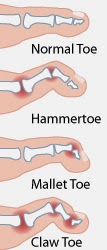
This picture is from a site called our health network. com I think it is great to show what is going on with the different types of toe issues.
B.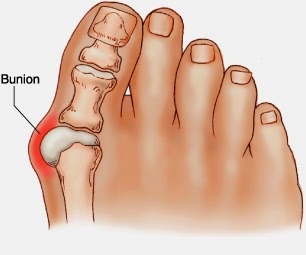
This picture is from a site called md guide lines. This condition can often be seen joining hammer toes.
Most of the toe issues I see are in Women. The main reason for this is our footwear. For the most part stylish shoes for women tend to be too pointy, too tight, high-heeled and sometimes too short. These conditions on a repeated basis cause pressure on the toes. Over time this pressure leads to toe muscle imbalance which leads to a pull and tension on the toe tendons. The longer the tendons are held under tension, they will become rigid and pull the toe joints out of alignment.
All of the conditions pictured above can start with poor, unhealthy footwear.
Another cause for Hammer toes is muscle imbalance starting in the low leg. When the calf muscles are overworked or over contracted and are not taken back to their normal resting length, the tendons of these muscles are placed under tension. The low leg muscle tendons end on the bones of the foot and toes. As these tendons pull the joints out of alignment and inflammatory process can occur. This process can then lead to Arthritis. Once Arthritis is on the scene we have a revolving door where one issue contributes to the other.
Finally, some people are prone to Hammer toes because their DNA sets them up for weaker or unstable structural support. A couple of examples would be flat feet or high arches. These conditions do not present by themselves, they usual arise from a postural deformity. The combination of the unstable structural support and muscle imbalances that follow lead to what has been described above.
What is going on exactly with the joints to show up as what we call Hammer toes?
C.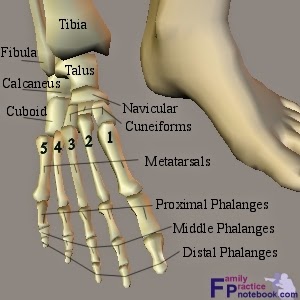
We can see the placement of the phalanges (Toe bones) in this great picture from fp notebook.
In a Hammer toe the metatarsal bone has bent down toward the floor shortening the tendon which causes the middle phalanges to raise up (refer back to picture A). A side effect of this joint raise is some degree of skin blister, callus or corn.
Claw toes like Hammer toes are the result of muscle imbalances, leading to ligament and tendon tension which leads to the mis-alignment of the toe joints. Again as with Hammer toes, this condition can have a revolving door occurrence with Arthritis.
What sets a Claw tow apart from a Hammer is the affect joint position. It is believed that Claw toes are never seen affecting the Big toe. In a claw tow, again, the metatarsal bones are bent down toward the floor. However, now the middle and distal phalanges raise up.
One will most likely see a Mallet toe in the second toe, as this toe tends to be the longs toe on many feet. Like the other two, the issue starts with the metatarsal bending down toward the floor. However, the only joint affected here is the distal phalanges.
Now what is happening with the accompanying Bunion often seen with Hammer toes?
Take a look at picture B. What you are seeing is the Big toe bone being pushed toward the first toe. Sometimes the Big toe can be pushed over or under the first toe depending on the degree and angle of pressure. The longer pressure is applied to the Big toe bones, gradually the metatarsal bone will migrate lateral (to the outside).
D. 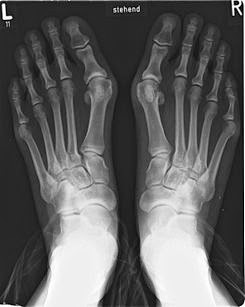
This is nicely shown in this picture from wikipedia.
Over time, if left in this condition, the lateral (outer edge) of either or both of the lateral head of the metatarsal or lateral aspect of the distal head of the proximal phalanges can develop an over growth (thickening) of bone or tissue. For the most part the larger bump that is seen is the normal anatomy of the head of the metatarsal. The area often being tender to touch, red and swollen is the bursal sac at the joint junction. If the pinky toe is affect it is termed a bunionette.
It is interesting to note, people who live in cultures where they go barefoot all the time, lack signs of bunions. This would suggest that the major cause of bunions is ill fitting shoes.
I believe with early detection all of these conditions can be prevented or at least supported in a fashion in which they remain mild, do not lead to more issues and do not require surgical correction.
Even if you have had one or more of these conditions for a while we can help to stop its progress and provide better out comes if surgery is believed necessary.
How can massage help these conditions?
1. we can locate the source of a postural issue and help to bring awareness and hopefully correction.
2. we can help to re-align muscles to help correct the muscle imbalances which in turn can alleviate the tension on the ligaments and tendons
3. with paraffin treatments we can help to bring new blood and oxygen to the ligament and tendons which in turn will help regain their flexibility and thus allow the joints to move back into proper alignment with time.
What will you need to do to help your massage process be its most effective?
1. be willing to wear healthier shoes
ones that have wider toe boxes, are flat and the proper size
2. speak to your MD regarding splints or other corrective devices
3. become aware of your posture and work to alter it to help balance your muscles
As always discuss your issues and how to treat them with your MD. So that you can go into your MD with more information check out healthyfeetstore.com to find great ideas for sandals, socks, shoes and devices. For a jumping off point google Correct Toes. For more support google Yoga Toes.
These are just a few ideas which with team work can help achieve healthy, pain free, sandal friendly feet.
For an appointment to plan for massage ways to address your foot issues visit :
Thursday, May 29, 2014
Paraffin more than a Spa Treatment
Most people know about paraffin wax from going to a spa. The salon/spa industry has been using paraffin wax for years to help soften and moisturize hands and feet.
Well, paraffin treatments have been around since ancient times and have been used for much more than just soft hands and feet.
A nurse friend of mine reminded me some doctors will recommend and write prescriptions for home paraffin dips after certain hand, elbow and foot surgeries. This got me to research how paraffin could help create a more effective massage experience.
I have found, in literary research, paraffin is used to help the following conditions:
1. Arthritis
2. Osteoarthritis
3. Scleroderma
4. tendonitis
5. bursitis
6. ligament issues
7. Muscles strains
8. Muscle sprains
9. Scar tissue
What is paraffin?
It is a component of crude mineral oil, which is refined or separated, purified, chilled and filtered into its usable form. It has a heavy molecular weight.
How does it work?
The paraffin is warmed to approximately 120-125 degrees to become a liquid. In this state a person either dips their limb into a wax bath or it is brushed on or placed into a bag/glove. The heat from the warmed wax penetrates the skin. The heat and the heavy molecular weight of the oil increases local blood flow (circulation is improved) and the muscles can relax as a result. The wax helps to open pores while at the same time draws the bodies natural oils to the surface. As the wax remains on the skin and cools the body's oils can then re-moisturize the local skin. If extra oil is applied to join with the body's natural oil then even greater moisturizing occurs. Some times an area having long standing scar tissue develops limited blood flow and lymphatic movement. When this happens the area can retain fluid. Paraffin's ability to open pores and activate both blood and lymph circulation can draw the excess fluid from the localized area.
I currently have been getting results with arthritic type of hand conditions, hammer toe issues of the foot and scar tissue related fluid retention. I have been using the paraffin to help me give a deeper massage with less discomfort. It has also been useful in softening the connective tissue of the tendons to allow me to work with the muscles without having a pull from the tendons. This has greatly helped give longer lasting results of straightening toes know as hammer toes.
The following conditions are not suited for paraffin:
1. Uncontrolled hypertension
2. Diabetes
3. Varicose veins
If you are interested in trying paraffin for yourself please feel free to book any time by going to
http://eclectichealingguide.fullslate.com/
Also remember to do your own research and discuss your options with your health care provider before starting any treatments which are not familiar to you.
Subscribe to:
Posts (Atom)