The importance of castor oil improving the lymph system
1. Poor lymphatic drainage can be settle. Most people don't notice any issues with their lymph drainage and most doctors don't take notice until it is a sever problem seen as edema ( swelling)
2. When cells are pushed away from blood vessels and the chance to receive nutrients and oxygen from the blood they become unhealthy,
3. If the lymph is not moving, then cells are slow at dumping their waste and toxins outside of their shells. Not only does this happen with individual cells but it happens with organs.
4. Increase of fluid outside of cells in the spaces between tissues cause the skin to stretch which puts pressure on the surrounding structures. This leads to stagnation/blockage and pain.
5. So far I do not know of a drug that helps improve the flow of lymphatic system. If there were MDs would be using it as a cure for lymphedema. To date the MDs say there is no cure for lymphedema
What happens when castor oil is absorbed through the skin
1. The # of lymphocytes in the blood increases. This improves the immune system.
2. The lymph begins to move , which in turn moves cellular waste and toxins. Which improves muscle nutrition and function.
3. The lymph in the intestinal lining is better able to absorb fat molecules and help the body which allows the cell the chance for growth and repair
4. The area is stimulated to self lubricate better.
This is just a short example of how castor oil interacts with the lymphatic system. For more information contact me via email and I can send the next installment.

Colette-Eclectic Healing Guide is connected to: www.colette.massagetherapy.com FaceBook @Eclectichealingguide and Instagram @eclectichealingguide. All information in this Blog is for Educational purposes only! Please Consult your Health Care Provider concerning any disease or injury. The author is Not recommending that you self-diagnose or self-prescribe. Please discuss with your Health Care Provider before introducing anything new to your wellness routine.
Showing posts with label self care. Show all posts
Showing posts with label self care. Show all posts
Thursday, February 2, 2017

Thursday, October 8, 2015
The Heart Rules Our Posture
Did you ever wonder why the world is dominated by all things right sided?
Start to look around at your fellow humans. You might begin to notice the right side dominance isn't just about people using their right hands. Oh no, it goes much deeper than the activity of the right hand.
The right side dominance largely develops out of the size and position of the heart. The heart itself is not symmetrical. It has 4 chambers, two atria and two ventricles; with the left ventricle being the largest of the chambers. These chambers create the body of the heart which is located mostly on the left of the body with a slight tilt to the right and behind the sternum. As it takes up a significant portion of the upper left compartment of the chest cavity the other organs develop around it asymmetrically.
Separated by the heart are the Lungs. Though there are two lungs they are not equal. The left lung only has two lobes to allow the heart to tuck within and slightly behind it. The right lung dominates the right side of the chest cavity with three lobes. Moving down to the feet we find the lungs contacting the parachute like diaphragm. Again because of the heart's position on the left the diaphragm has to extend higher on the right side of the body.
From the diaphragm we move down toward the feet again and into the abdominal cavity. Here the largest part to the liver is tucked up into the diaphragm on the right side of the body. There are four lobes to the liver with three on the right side and the smaller forth portion positioned behind the sternum and contacting the stomach to the left of the body.
Are you starting to get the picture? Because we value are heart so much we have heavily weighted the right side of our body to compensate for the room we've given the heart. For most of us this means we will lean to the right. Do some people watching. Ask your friends how many of them have problems on their right hips, legs, feet and left shoulders. The reason for this cross body phenomena is partially the heart's dominance and creation of the internal asymmetry of the internal organs.
Subconsciously, then, the world becomes built around this right side heaviness so to speak. Then we begin to favor our right hands and we further the asymmetrical repetitive habits.
We are given two arms and two legs with symmetry to compensate for the asymmetry created by the heart. We are ideally suppose to use our left arm and right leg (and visa verse) to move us forward. The heads of our femurs are suppose to move within the hip sockets like pistons (up and down and backward and forward). However for most of us we lack movement in the pelvic girdle and the femur heads move out of the sockets to the outside of the body before moving forward.
There are a few people out there who use both sides of their body equally and have not paid attention to the right side weight. Most of us are not that lucky and must start to bring more awareness to your left side. Play around with taking your first step with your left foot, reach for items with your left hand and pick things up with your left hand. This will begin to retrain your brain. See how long it takes your posture to change as you reprogram your brain with reciprocal movement.
In future posts I will discuss how to continue to reprogram the brain by addressing the Diaphragm's right side dominance. I believe when we understand the functioning of the diaphragm we begin to understand the body's true core is the diaphragm. This realization will revolutionize your postural awareness. Stay tuned....
Tuesday, July 28, 2015
Who's The Real Master of Your Work Out
You may think you and your trainer are in charge of your work outs. Or maybe you think it's your muscles. Really the true master in charge of your work outs and for that matter your every day functional movement is your Fascia.
For decades now fascia has been on the back burner when it comes to discussing how the body functions. Some of the leading instructors in the world of body work have been over looked for the important information they have to offer to the wellness industry because their fascial information was largely not understood. The science behind fascia was slow to reveal itself.
Now the science is here and fascia is set to revolutionize health care. You can't speak about any aspect of the human being without speaking about its connection to fascia. Fascia is in every cell of the human body. Fascia is the bridge, the inter/intra-connector of every structure/matter within the body. It also creates and applies the tension and compression to every structure it weaves with.
Fascia is the reason your skeleton stays erect and your organs don't flap out of your stomach onto the ground. It is what helps your blood clot and begin your wound healing. The webbing of fascia is the telephone lines for your nerves to communicate information from your brain to cause your body to function.
Your fascia is the best net -worker you will ever meet. It can in an instance respond to the slightest movement from the tilt of your head to view your text message to the tip of your big toe as you move your foot without thinking while responding to the text. It is the mover and shaker of your world, knowing everyone and everything that goes on with this world (so to speak).
My go to person when it comes to information and research on fascia is Thomas Myers, the author of Anatomy Trains. Tom defines fascia as, "the extracelluar matrix of fibers 'glue' and water surrounding all your cells and wrapping like plastic wrap around muscles fibers, muscles, muscles groups, organs, bones, blood vessels and nerves." Another way of saying this is fascia is both a solid and a liquid capable of moving, causing movement or preventing movement from occurring. Seeing fascia in this manner we begin to understand why it is the master in charge of our work outs.
As with all things in our body, some areas are healthier than others and this is true of fascia. When fascia is in its healthiest state it moves and functions most like a fluid, gently embracing and supporting the body as a whole. On the flip side it can be in a hyper-defensive mode acting like a straight jacket locking everything down. When fascia claps down on muscles and other structures it can also trap fat causing areas to appear clumped, chunky and/or cellulite ridden. Ever feel like you work out hard, eat all the right, healthy foods but still have chunky areas and cellulite? This may be due to the fact you have not been paying attention to how to care for your fascia.
Defensive fascia also creates areas of stagnation. This is like a traffic back up on the free way and emergency vehicles trying to get through. It can be done but with much difficulty and very slowly. In the body this means areas where the brain can't signal the muscles properly. This translates to the appearance of weak muscles even though you have been working out for weeks. In truth your work out potential is not dependent on your muscles but on your fascia. You won't really know what your muscles are truly cable of until you allow the full, free and healthy functioning of your fascia.
Here are a few things, according to Tom Myers, we currently know about fascia:
1. Unlike what has been thought and taught, most injuries are connective tissue not muscular injuries
2. There are 10x as many sensory nerve endings in your fascia than in your muscles
3. Due to the misunderstanding regarding the body's functional movement traditional anatomy texts are inaccurate.
According to Tom Myers, here are some ideas to help fascia health and thus overall body health?
1. Enhance the elasticity of the fascia by engaging in full body slow, sustained, multi- plane, multi- directional stretching which will help prevent adhesions from forming
2. Give fascia plenty of water. The fascia has what is called GAG= glycoaminoglycans these are water absorbing proteins. These proteins allow the fascia to lengthen which is what we see as a stretch
3. Connective tissue/ fascia responds best to opposing muscle repetitive motion exercise such as walking, running and bouncing
4. Avoid jerky, abrupt changes in direction during your work outs
5. I can't stress enough how important it is to move slowly when it comes to fascia. It might take
6 -24 months to train fascia so be patient
6. Fascia requires variety in angle, tempo and load this is where cross training comes into play
7. Go for whole body movements that require constant adaptation i.e. constantly challenge your body in new ways. For example, instead of just walking on smooth flat trails and the same trail in the same direction every day, vary your trail, have level changes and texture changes, and direction
8. Avoid repetitive movement within a work out. You want to have very easy to very hard in the same task. You want to vary your load as you go as well.
9. Proprioception and kinestheasia are primarily fascial in nature not muscular. Due to the fact that fascia has 10 x more sensory nerves your muscles can't move without the fascia moving first. Play around with feather touch to sense your fascial responses. Slow elegant movement is best.
10. Unlike muscles, with fascia you want to think in chains. When you think about working your pectoral muscles you must also think about working your second finger because of the fascial strap extending from one to the other down the arm.
11. Rest is important! Fascia goes through a cycle of becoming weak immediately after a heavy work out to gaining more strength the day after. You want to rest between events and you must have total rest days. The new rule of thumb for rest periods during work outs is 5 mins of rest for every 25 mins of work out. For total rest days that means no working out at all; no aerobics, no yoga; nothing other than normal daily actives like walking to the car or around the house to get from one place to the other. A total rest day should be about pampering. You want to soak in the tub, take naps, mediate or just be a couch potato guilt free!
Hydration for your fascia:
A couple signs that your fascia is lacking water would be the appearance of wrinkles, the change in focal length of the iris in the eye.
The body is made up of between 75-95% water. The baseline hydration for a healthy functioning person is half (1/2) the body weight in ounces (oz) of plain water each day. This is roughly 8-10 eight oz glasses of plain water.
How to calculate your baseline plain water intake:
Take your body weight 120 lb divide by 2 = 60 convert the 60 to ounces
Take 60 divide by 8 ounces = 7.5
7.5 is the # of 8 ounce glasses of plain water you should drink per day.
I keep saying plain water ,why? Because tea or something like sugared, fruit juice may not be a hydrating fluid. Some teas will cause you to increase urination. Increased urination will lead to dehydration. Sugared fruit juice (meaning juice with added sugar) will make the body work harder to process the synthetic sugar which can lead to dehydration.
Some of you might be thinking but there are times when I drink plain water all day long and I still feel thirsty. This could be due to your body for some reason not being able to get the water from the spaces surrounding the tissue inside the cell. If water doesn't get into the cell so it can be used you will just eliminate it in the urine.
Now you ask, how can I get my 7.5 glasses of water into my cells? You need to bind it to a mineral. This is where electrolyte water comes into play. The most natural and most medicinal electrolyte water is out of a fresh, green coconut. Coconut water is the same make up as your blood plasma. It contains all the mineral, amino acids etc your body needs for functional hydration.
Hold on, I don't like the taste of coconut water, for that matter I don't like the taste of plain water. What can I do? Now we turn to fruits and vegetables. The most water filled fruits and vegetables are, watermelon, pears,grapes, cucumbers, and spinach. Other foods to help bind the plain water and get it into the cell are lemons and vinegar. And another way to add an electrolyte to your water is to add real/natural salt. Natural salt doesn't have anything added or taken out of it and it usually has a color (brown, pink or black). There can be up to 60 trace mineral in natural salt. Celtic sea salt, Himalayan salt, and Redmond real salt would be the types to add to your water.
How to make your own electrolyte water:
1. Get a pitcher of water,
2. Cut up one or more of the fruits and vegetables listed above
3. Get a pinch or two of the salt listed
4. If you need a bit of sweet then a teaspoon of raw honey or Xylitol will be good
5. Combine it all in the pitcher
6. For the best results allow the water to combine with everything for at least 30 mins
7. Drink and enjoy
Another way to get your water into your cells is through movement. Gentle pumping, rolling and or compression of the tissues can move the water from out side to inside a cell. Finally you have truly and completely hydrated your body and your fascia.
We can't leave a discussion about hydration and fascia without speaking about the abdomen. We must have a healthy, functioning stomach and digestive system to have good absorption of water once we have finished drinking our 7.5 glasses. If the stomach, small intestine and large intestine are not breaking down food well and taking up the water into our tissue we will not see any results from our hydration attempts. One way to enhance the health of the abdomen is through abdominal massage. When abdominal massage is performed you will have your skin, muscles, internal organs as well as your stomach and intestines worked out. This form of massage helps digestion, elimination, stimulates the lymphatic system, improves the circulatory system and immune system. It can also helps with posture, chronic neck, pack, pelvis, feet and shoulder issues. The respiratory system, and reproductive systems are greatly, positively affected by this technique as well.
To bring it back to working out what are we looking at when we want to exercise our fascia? When thinking about your work out and fascia the main things to remember are variety, hydration, rest and smooth, gentle flow.
If you are doing a weight work out, it might look something like:
Start with no weight at all, use only your body weight and do isometric contractions. Then move to a couple repetitions with a theraband/rope. Transition to machines and vary the weight of each machine you do going from very easy weight to your max. Remember 5 mins of rest for every 25 mins of working out. So take 2-3 mins to shake out your muscles between each transition. Take a sip of water and breath as you go from one area to the other.
To bring the idea of variety into your work out week. Try exercising outside one day by walking or running (remember bicycling is not the best fascial type work out). Use a mini-trampoline playing with height and what you do on it (walk, run, swing your arms). If you haven't done Tai Chi or yoga look into these forms of exercise. Take a dance class one night a week. When you do this, you are doing more than just working your muscles and you can see how the master of your work out will revolutionize your being.
I hope this was helpful information and has given you something new to think about while you work out. I also hope by incorporating some of the tips you will decrease your body aches and pains.
As always remember to speak with your medical provider before changing your diet or exercise program.
For decades now fascia has been on the back burner when it comes to discussing how the body functions. Some of the leading instructors in the world of body work have been over looked for the important information they have to offer to the wellness industry because their fascial information was largely not understood. The science behind fascia was slow to reveal itself.
Now the science is here and fascia is set to revolutionize health care. You can't speak about any aspect of the human being without speaking about its connection to fascia. Fascia is in every cell of the human body. Fascia is the bridge, the inter/intra-connector of every structure/matter within the body. It also creates and applies the tension and compression to every structure it weaves with.
Fascia is the reason your skeleton stays erect and your organs don't flap out of your stomach onto the ground. It is what helps your blood clot and begin your wound healing. The webbing of fascia is the telephone lines for your nerves to communicate information from your brain to cause your body to function.
Your fascia is the best net -worker you will ever meet. It can in an instance respond to the slightest movement from the tilt of your head to view your text message to the tip of your big toe as you move your foot without thinking while responding to the text. It is the mover and shaker of your world, knowing everyone and everything that goes on with this world (so to speak).
My go to person when it comes to information and research on fascia is Thomas Myers, the author of Anatomy Trains. Tom defines fascia as, "the extracelluar matrix of fibers 'glue' and water surrounding all your cells and wrapping like plastic wrap around muscles fibers, muscles, muscles groups, organs, bones, blood vessels and nerves." Another way of saying this is fascia is both a solid and a liquid capable of moving, causing movement or preventing movement from occurring. Seeing fascia in this manner we begin to understand why it is the master in charge of our work outs.
As with all things in our body, some areas are healthier than others and this is true of fascia. When fascia is in its healthiest state it moves and functions most like a fluid, gently embracing and supporting the body as a whole. On the flip side it can be in a hyper-defensive mode acting like a straight jacket locking everything down. When fascia claps down on muscles and other structures it can also trap fat causing areas to appear clumped, chunky and/or cellulite ridden. Ever feel like you work out hard, eat all the right, healthy foods but still have chunky areas and cellulite? This may be due to the fact you have not been paying attention to how to care for your fascia.
Defensive fascia also creates areas of stagnation. This is like a traffic back up on the free way and emergency vehicles trying to get through. It can be done but with much difficulty and very slowly. In the body this means areas where the brain can't signal the muscles properly. This translates to the appearance of weak muscles even though you have been working out for weeks. In truth your work out potential is not dependent on your muscles but on your fascia. You won't really know what your muscles are truly cable of until you allow the full, free and healthy functioning of your fascia.
Here are a few things, according to Tom Myers, we currently know about fascia:
1. Unlike what has been thought and taught, most injuries are connective tissue not muscular injuries
2. There are 10x as many sensory nerve endings in your fascia than in your muscles
3. Due to the misunderstanding regarding the body's functional movement traditional anatomy texts are inaccurate.
According to Tom Myers, here are some ideas to help fascia health and thus overall body health?
1. Enhance the elasticity of the fascia by engaging in full body slow, sustained, multi- plane, multi- directional stretching which will help prevent adhesions from forming
2. Give fascia plenty of water. The fascia has what is called GAG= glycoaminoglycans these are water absorbing proteins. These proteins allow the fascia to lengthen which is what we see as a stretch
3. Connective tissue/ fascia responds best to opposing muscle repetitive motion exercise such as walking, running and bouncing
4. Avoid jerky, abrupt changes in direction during your work outs
5. I can't stress enough how important it is to move slowly when it comes to fascia. It might take
6 -24 months to train fascia so be patient
6. Fascia requires variety in angle, tempo and load this is where cross training comes into play
7. Go for whole body movements that require constant adaptation i.e. constantly challenge your body in new ways. For example, instead of just walking on smooth flat trails and the same trail in the same direction every day, vary your trail, have level changes and texture changes, and direction
8. Avoid repetitive movement within a work out. You want to have very easy to very hard in the same task. You want to vary your load as you go as well.
9. Proprioception and kinestheasia are primarily fascial in nature not muscular. Due to the fact that fascia has 10 x more sensory nerves your muscles can't move without the fascia moving first. Play around with feather touch to sense your fascial responses. Slow elegant movement is best.
10. Unlike muscles, with fascia you want to think in chains. When you think about working your pectoral muscles you must also think about working your second finger because of the fascial strap extending from one to the other down the arm.
11. Rest is important! Fascia goes through a cycle of becoming weak immediately after a heavy work out to gaining more strength the day after. You want to rest between events and you must have total rest days. The new rule of thumb for rest periods during work outs is 5 mins of rest for every 25 mins of work out. For total rest days that means no working out at all; no aerobics, no yoga; nothing other than normal daily actives like walking to the car or around the house to get from one place to the other. A total rest day should be about pampering. You want to soak in the tub, take naps, mediate or just be a couch potato guilt free!
Hydration for your fascia:
A couple signs that your fascia is lacking water would be the appearance of wrinkles, the change in focal length of the iris in the eye.
The body is made up of between 75-95% water. The baseline hydration for a healthy functioning person is half (1/2) the body weight in ounces (oz) of plain water each day. This is roughly 8-10 eight oz glasses of plain water.
How to calculate your baseline plain water intake:
Take your body weight 120 lb divide by 2 = 60 convert the 60 to ounces
Take 60 divide by 8 ounces = 7.5
7.5 is the # of 8 ounce glasses of plain water you should drink per day.
I keep saying plain water ,why? Because tea or something like sugared, fruit juice may not be a hydrating fluid. Some teas will cause you to increase urination. Increased urination will lead to dehydration. Sugared fruit juice (meaning juice with added sugar) will make the body work harder to process the synthetic sugar which can lead to dehydration.
Some of you might be thinking but there are times when I drink plain water all day long and I still feel thirsty. This could be due to your body for some reason not being able to get the water from the spaces surrounding the tissue inside the cell. If water doesn't get into the cell so it can be used you will just eliminate it in the urine.
Now you ask, how can I get my 7.5 glasses of water into my cells? You need to bind it to a mineral. This is where electrolyte water comes into play. The most natural and most medicinal electrolyte water is out of a fresh, green coconut. Coconut water is the same make up as your blood plasma. It contains all the mineral, amino acids etc your body needs for functional hydration.
Hold on, I don't like the taste of coconut water, for that matter I don't like the taste of plain water. What can I do? Now we turn to fruits and vegetables. The most water filled fruits and vegetables are, watermelon, pears,grapes, cucumbers, and spinach. Other foods to help bind the plain water and get it into the cell are lemons and vinegar. And another way to add an electrolyte to your water is to add real/natural salt. Natural salt doesn't have anything added or taken out of it and it usually has a color (brown, pink or black). There can be up to 60 trace mineral in natural salt. Celtic sea salt, Himalayan salt, and Redmond real salt would be the types to add to your water.
How to make your own electrolyte water:
1. Get a pitcher of water,
2. Cut up one or more of the fruits and vegetables listed above
3. Get a pinch or two of the salt listed
4. If you need a bit of sweet then a teaspoon of raw honey or Xylitol will be good
5. Combine it all in the pitcher
6. For the best results allow the water to combine with everything for at least 30 mins
7. Drink and enjoy
Another way to get your water into your cells is through movement. Gentle pumping, rolling and or compression of the tissues can move the water from out side to inside a cell. Finally you have truly and completely hydrated your body and your fascia.
We can't leave a discussion about hydration and fascia without speaking about the abdomen. We must have a healthy, functioning stomach and digestive system to have good absorption of water once we have finished drinking our 7.5 glasses. If the stomach, small intestine and large intestine are not breaking down food well and taking up the water into our tissue we will not see any results from our hydration attempts. One way to enhance the health of the abdomen is through abdominal massage. When abdominal massage is performed you will have your skin, muscles, internal organs as well as your stomach and intestines worked out. This form of massage helps digestion, elimination, stimulates the lymphatic system, improves the circulatory system and immune system. It can also helps with posture, chronic neck, pack, pelvis, feet and shoulder issues. The respiratory system, and reproductive systems are greatly, positively affected by this technique as well.
To bring it back to working out what are we looking at when we want to exercise our fascia? When thinking about your work out and fascia the main things to remember are variety, hydration, rest and smooth, gentle flow.
If you are doing a weight work out, it might look something like:
Start with no weight at all, use only your body weight and do isometric contractions. Then move to a couple repetitions with a theraband/rope. Transition to machines and vary the weight of each machine you do going from very easy weight to your max. Remember 5 mins of rest for every 25 mins of working out. So take 2-3 mins to shake out your muscles between each transition. Take a sip of water and breath as you go from one area to the other.
To bring the idea of variety into your work out week. Try exercising outside one day by walking or running (remember bicycling is not the best fascial type work out). Use a mini-trampoline playing with height and what you do on it (walk, run, swing your arms). If you haven't done Tai Chi or yoga look into these forms of exercise. Take a dance class one night a week. When you do this, you are doing more than just working your muscles and you can see how the master of your work out will revolutionize your being.
I hope this was helpful information and has given you something new to think about while you work out. I also hope by incorporating some of the tips you will decrease your body aches and pains.
As always remember to speak with your medical provider before changing your diet or exercise program.
Thursday, January 22, 2015
Foods to Help Your Muscles and Body
Most of the time we can address and take care of many of our aches and pains by eating the correct foods. Yet often times we go to the store first too hungry to make healthy intentional selections. I know for myself if I've missed a meal before going food shopping I tend to purchase foods which are quick and easy. These choices often lack variety and generally are not balanced nor taking into consideration what is going on in my body outside of hunger.
Before I really started to think of food as medicine I generally didn't know what types of food to buy to target what I wanted to change in my body. I mainly purchased items to make a salad because a salad is healthy, right? I'd get some supplements because supplements will balance me out, right?
Now I'm a bit more aware. I try to consider the season I'm in and how my body is reacting to that season. I notice if I need to decrease inflammation or prepare for the flu season. I'm aware if I can't warm up my feet and hands. Then I go for foods to address these issues.
I can go into more detail at another time about seasonal eating but for this write up I'm going to focus on herbs and spices that can help your body.
1. Turmeric: is not only for curry. It is one of the leading medicine foods and has been for decades.
It is a great anti-inflammatory
It is a strong anti-oxidant
It is an anti-coagulant
It helps improve brain function
It helps improve endothelial function
which plays a role in decreasing heart disease
It's an anti-cancer
2. Ginger: most widely know for is benefits to help reduce nausea and stomach upset.
It helps blood flow and circulation with helps
the body thermo-regulate
It's an anti-inflammatory
It's an anti-cancer
It helps break down and release mucus
It improves the immune system
It decrease plaque build up in the arteries
3. Cinnamon: is not just for baking
It helps reduce blood sugar levels
It supports blood platelets and thus
helps improve blood clotting
It helps reduce blood pressure
4. Mustard : not just for your sandwich
It is great as a quick combatant of muscle spasms
It helps reduce muscle pain
It helps improve nerve impulses
5. Cardamom: not just for rice pudding
It helps detox the kidneys
It's an anti-inflammatory
It helps reduce muscle spasm
All of these to some degree are anti-bacterial, anti-fungal and anti-vital.
As with any medicine not every one should use these as a medicine, meaning take them at high levels on a daily basis for an extend period of time. For instance someone who is prone to gallstones should not take turmeric. Someone on blood thinners should not take the one's promoting anti-coagulation.
Always consult your Naturopath or other health care provide when seeking to change your system's regulators.
Before I really started to think of food as medicine I generally didn't know what types of food to buy to target what I wanted to change in my body. I mainly purchased items to make a salad because a salad is healthy, right? I'd get some supplements because supplements will balance me out, right?
Now I'm a bit more aware. I try to consider the season I'm in and how my body is reacting to that season. I notice if I need to decrease inflammation or prepare for the flu season. I'm aware if I can't warm up my feet and hands. Then I go for foods to address these issues.
I can go into more detail at another time about seasonal eating but for this write up I'm going to focus on herbs and spices that can help your body.
1. Turmeric: is not only for curry. It is one of the leading medicine foods and has been for decades.
It is a great anti-inflammatory
It is a strong anti-oxidant
It is an anti-coagulant
It helps improve brain function
It helps improve endothelial function
which plays a role in decreasing heart disease
It's an anti-cancer
To improve the effectiveness of Turmeric we must enhance the absorption of it's chemical Curcumin. This is done by combining it with ground black pepper.
Note: most research finds Turmeric to be an estrogen inhibitor. However, there have been a few articles that state too much turmeric can increase the levels of estrogen in the blood. Therefore, to be cautious, I try to limit the amount of turmeric and forms of turmeric in a day. In one day rather than adding it to a smoothie, drinking it as a tea, eating it as a curry and taking it as a supplement, I choose one or two of these options. This is true for any thing we consume; too much of a good thing can become a bad thing.
2. Ginger: most widely know for is benefits to help reduce nausea and stomach upset.
It helps blood flow and circulation with helps
the body thermo-regulate
It's an anti-inflammatory
It's an anti-cancer
It helps break down and release mucus
It improves the immune system
It decrease plaque build up in the arteries
3. Cinnamon: is not just for baking
It helps reduce blood sugar levels
It supports blood platelets and thus
helps improve blood clotting
It helps reduce blood pressure
4. Mustard : not just for your sandwich
It is great as a quick combatant of muscle spasms
It helps reduce muscle pain
It helps improve nerve impulses
5. Cardamom: not just for rice pudding
It helps detox the kidneys
It's an anti-inflammatory
It helps reduce muscle spasm
All of these to some degree are anti-bacterial, anti-fungal and anti-vital.
As with any medicine not every one should use these as a medicine, meaning take them at high levels on a daily basis for an extend period of time. For instance someone who is prone to gallstones should not take turmeric. Someone on blood thinners should not take the one's promoting anti-coagulation.
Always consult your Naturopath or other health care provide when seeking to change your system's regulators.
Tuesday, July 22, 2014
Bright Moon has Come
Though, as I write this we are under the influence of the waning, crescent moon, I will be sharing about the Full Moon.
We entered the phase of the Full Moon on July 13th. Interesting to me, these days many people will do ceremonies or discuss the menses (bleeding time) at the Full Moon. That is what I did before I started to really question my cycles and started to learn about Chinese medicine. However, during the times when women were governed by natural light, they would have been dealing, for the most part, with their ovulation time under the Full of the Moon.
The Full Moon energy is linked to a woman's Pineal gland. When we go to sleep and how much light is present as we move into bed will affect the signals coming and going from the Pineal gland. If we go to bed as the sun sets without artificial light the Pineal gland will send hormones to the ovaries to start the release of the ripe egg. If we have been tracking with the moon, this release will occur within three days of the Full Moon.
Full Moon energy is the Power time for the Moon and most women. It is the time when the night sky is bright and alive. You can get around in the forest without a flashlight, which means you can extend your day if you desire. With the moon bright, like the sun, you can absorb energy and have more available to give. This can also be seen as a time to make decisions.
If you are aware of when you ovulate, have you noticed your energy during that time? Have you noticed you are more out going? Is this the time you want to go dancing, have a party and get dressed up? Have you noticed your energy is more of a drawing to you kind of energy? Have you noticed you attract more people to you especially men? Is this the time you are more sexual? And if you bleed at this time, do you notice, unlike some women who say they are sluggish and more inward, you feel more alive and energized?
Why is your energy so high at Ovulation? Well, it is your body's way of pushing you to take advantage of the small window to do something with the Potential of life ripe in your body. The ripened egg has about 12 to 72 hours viability for fertilization. So it is no wonder your energy is magnetizing people to you. Why do we start measuring our cycle with our bleeding time? The obvious reason is we have a definite marker, we see blood. Thus, the first sign, of something more than a spot, of blood is marked as day one of our cycle. As I said in other posts when healthy we follow, in general, a 28 day cycle with the moon. The midway point will call us to look for signs of ovulation. One subtle indicator is the occurrence of a slight pain/cramp in your lower stomach usually on one side. Note the side can vary month to month (we tend to alternate ovaries).
The second sign actually takes a couple of months of tracking in order to see your pattern. It also can be related to the idea of brightness corresponding to energy. What I mean by this is the amount of focus light generates more energy which in turn can generate more heat. This second sign is temperature. Again start to monitor your temperature at day one of your bleeding time. During this first phase of your cycle Estrogen dominates. You are in your Yin phase which is about cooling,gentle feminine energy and thus you will notice your temperature to be lower from day one to about 13. As Progesterone increases so too will your temperature. You have now entered your masculine phase (Yang) and your body is preparing your uterus for the implantation of your fertilized egg. Masculine energy is about manifesting, bringing forward what the feminine initiated and making the potential real. You will see your highest temperature the day you release the ripe egg=ovulation. You will be as bright, and full as the Moon, while burning like the Sun.
The third sign, I relate again to Yin. Our cervical fluid becomes more abundant and more flowing, like albumen of the egg white. Our feminine process of softening comes into play as we soften our cervix to receive as women do. That drawing energy I mentioned above comes in the form of pulling our cervix upward. We also open our cervix, as a flower blooms. We have now prepared ourselves to receive the spark of life, our partners sperm.
What if you don't want to get pregnant? Have you thought about creating a ceremony to honor this creative, potential? If you have tracked your cycle and you know when you are going to ovulate what about planning a gathering in which you and your girl friends have a crafting party? Maybe you and your partner can do something other than create a baby, like build furniture together or plant a garden? Maybe you can take an art class and create something with paint or clay? Maybe you can do a meditation to learn more about your second chakra and how it relates to being the creator of your world?
I invite you to feel the juiciness of your Full Moon, Ovulatory potential! May we together be the change we are looking for by becoming more in tune with our cycles. May we join our cycles with that of Mama Gaia, and give birth to a new World.
Monday, July 21, 2014
Where are the Toes
Have you ever looked at your feet and wondered what was going on with those toes?
Since most of us regularly and frequently wear shoes and often wear shoes more for style than health and comfort, most of us have some mis-alignment of our feet and toes.
It is interesting to note, people who live in cultures where they go barefoot all the time, lack signs of bunions. This would suggest that the major cause of bunions is ill fitting shoes.
I believe with early detection all of these conditions can be prevented or at least supported in a fashion in which they remain mild, do not lead to more issues and do not require surgical correction.
Even if you have had one or more of these conditions for a while we can help to stop its progress and provide better out comes if surgery is believed necessary.
How can massage help these conditions?
1. we can locate the source of a postural issue and help to bring awareness and hopefully correction.
2. we can help to re-align muscles to help correct the muscle imbalances which in turn can alleviate the tension on the ligaments and tendons
3. with paraffin treatments we can help to bring new blood and oxygen to the ligament and tendons which in turn will help regain their flexibility and thus allow the joints to move back into proper alignment with time.
What will you need to do to help your massage process be its most effective?
1. be willing to wear healthier shoes
ones that have wider toe boxes, are flat and the proper size
2. speak to your MD regarding splints or other corrective devices
3. become aware of your posture and work to alter it to help balance your muscles
As always discuss your issues and how to treat them with your MD. So that you can go into your MD with more information check out healthyfeetstore.com to find great ideas for sandals, socks, shoes and devices. For a jumping off point google Correct Toes. For more support google Yoga Toes.
These are just a few ideas which with team work can help achieve healthy, pain free, sandal friendly feet.
For an appointment to plan for massage ways to address your foot issues visit :
http://eclectichealingguide.fullslate.com/ .
Since most of us regularly and frequently wear shoes and often wear shoes more for style than health and comfort, most of us have some mis-alignment of our feet and toes.
A.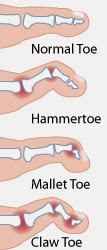
This picture is from a site called our health network. com I think it is great to show what is going on with the different types of toe issues.
B.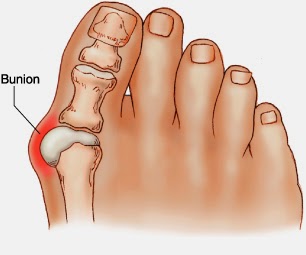
This picture is from a site called md guide lines. This condition can often be seen joining hammer toes.
Most of the toe issues I see are in Women. The main reason for this is our footwear. For the most part stylish shoes for women tend to be too pointy, too tight, high-heeled and sometimes too short. These conditions on a repeated basis cause pressure on the toes. Over time this pressure leads to toe muscle imbalance which leads to a pull and tension on the toe tendons. The longer the tendons are held under tension, they will become rigid and pull the toe joints out of alignment.
All of the conditions pictured above can start with poor, unhealthy footwear.
Another cause for Hammer toes is muscle imbalance starting in the low leg. When the calf muscles are overworked or over contracted and are not taken back to their normal resting length, the tendons of these muscles are placed under tension. The low leg muscle tendons end on the bones of the foot and toes. As these tendons pull the joints out of alignment and inflammatory process can occur. This process can then lead to Arthritis. Once Arthritis is on the scene we have a revolving door where one issue contributes to the other.
Finally, some people are prone to Hammer toes because their DNA sets them up for weaker or unstable structural support. A couple of examples would be flat feet or high arches. These conditions do not present by themselves, they usual arise from a postural deformity. The combination of the unstable structural support and muscle imbalances that follow lead to what has been described above.
What is going on exactly with the joints to show up as what we call Hammer toes?
C.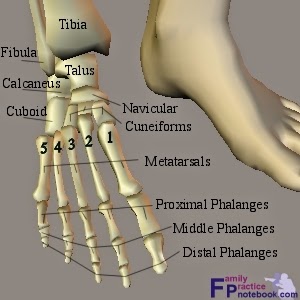
We can see the placement of the phalanges (Toe bones) in this great picture from fp notebook.
In a Hammer toe the metatarsal bone has bent down toward the floor shortening the tendon which causes the middle phalanges to raise up (refer back to picture A). A side effect of this joint raise is some degree of skin blister, callus or corn.
Claw toes like Hammer toes are the result of muscle imbalances, leading to ligament and tendon tension which leads to the mis-alignment of the toe joints. Again as with Hammer toes, this condition can have a revolving door occurrence with Arthritis.
What sets a Claw tow apart from a Hammer is the affect joint position. It is believed that Claw toes are never seen affecting the Big toe. In a claw tow, again, the metatarsal bones are bent down toward the floor. However, now the middle and distal phalanges raise up.
One will most likely see a Mallet toe in the second toe, as this toe tends to be the longs toe on many feet. Like the other two, the issue starts with the metatarsal bending down toward the floor. However, the only joint affected here is the distal phalanges.
Now what is happening with the accompanying Bunion often seen with Hammer toes?
Take a look at picture B. What you are seeing is the Big toe bone being pushed toward the first toe. Sometimes the Big toe can be pushed over or under the first toe depending on the degree and angle of pressure. The longer pressure is applied to the Big toe bones, gradually the metatarsal bone will migrate lateral (to the outside).
D. 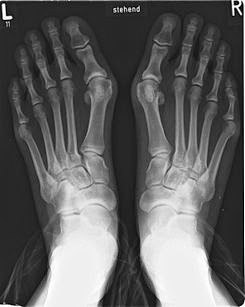
This is nicely shown in this picture from wikipedia.
Over time, if left in this condition, the lateral (outer edge) of either or both of the lateral head of the metatarsal or lateral aspect of the distal head of the proximal phalanges can develop an over growth (thickening) of bone or tissue. For the most part the larger bump that is seen is the normal anatomy of the head of the metatarsal. The area often being tender to touch, red and swollen is the bursal sac at the joint junction. If the pinky toe is affect it is termed a bunionette.
It is interesting to note, people who live in cultures where they go barefoot all the time, lack signs of bunions. This would suggest that the major cause of bunions is ill fitting shoes.
I believe with early detection all of these conditions can be prevented or at least supported in a fashion in which they remain mild, do not lead to more issues and do not require surgical correction.
Even if you have had one or more of these conditions for a while we can help to stop its progress and provide better out comes if surgery is believed necessary.
How can massage help these conditions?
1. we can locate the source of a postural issue and help to bring awareness and hopefully correction.
2. we can help to re-align muscles to help correct the muscle imbalances which in turn can alleviate the tension on the ligaments and tendons
3. with paraffin treatments we can help to bring new blood and oxygen to the ligament and tendons which in turn will help regain their flexibility and thus allow the joints to move back into proper alignment with time.
What will you need to do to help your massage process be its most effective?
1. be willing to wear healthier shoes
ones that have wider toe boxes, are flat and the proper size
2. speak to your MD regarding splints or other corrective devices
3. become aware of your posture and work to alter it to help balance your muscles
As always discuss your issues and how to treat them with your MD. So that you can go into your MD with more information check out healthyfeetstore.com to find great ideas for sandals, socks, shoes and devices. For a jumping off point google Correct Toes. For more support google Yoga Toes.
These are just a few ideas which with team work can help achieve healthy, pain free, sandal friendly feet.
For an appointment to plan for massage ways to address your foot issues visit :
Friday, May 30, 2014
New Moon and Being Female
On Wednesday we entered into the New Moon phase of the 28 day cycling of the Moon.
The cycling of the Moon can be divided into eight phases, each lasting approximately 31/2 days. This is very similar to the healthy cycling of a female.
It is my understanding the Moon's phases start with the New Moon. When we are relating these phases to how the cycle can be helpful to human daily activity it makes sense to start with the New Moon. From an astrological view the New Moon is a time of new beginnings, fresh starts, going in new directions. Here we can initiate new business ideas, create new facebook pages, plant seeds, make new lists of goals.
This phase is considered the dark time of the Moon. We on Earth can not see the Moon thus it appears dark. Also from Earth the Moon at this time is its closest to the Sun. You may not realize but the Moon at this time is really a crescent but due to its position between the Sun and Earth is is seen as a dark sphere.
In lunar calendars the New Moon marks the beginning of a month. When a woman is cycling in a healthy way she will usually have her first bleeding day on the first day of the New Moon. Like the New Moon she will stay in her dark phase (bleeding time) for approximately 31/2 days. She is at a time in her life where life and death are occurring at the same time. What this means is the unfertilized egg (potential life) is being shed with the lining that was to provide a home. At the same time a new follicle (egg) is being formed and starting on its journey to life.
This Wednesday's New Moon was linked to Gemini for you Astrology lovers. There is no wonder I have launched my new page 28 Days of Being Female during it's influence. Gemini does govern things related to the mind, sharing thoughts, learning, and being social.
I have decide to start this page because a lot of information is being shared these days about woman, the Full Moon and the bleeding time. I feel there is more to being Female than just how and when we bleed. As time goes on I will be exploring all phages of being female from pre-menses to menopause. I will also be welcoming women to share their thoughts and experiences with me.
I hope your next 28 days are filled with joy and beauty.
If you would like to fellow this page you can find it on facebook. Search 28 days of being female. Or go to
https://www.facebook.com/28daysfemale
Thank you for your interest!
The cycling of the Moon can be divided into eight phases, each lasting approximately 31/2 days. This is very similar to the healthy cycling of a female.
It is my understanding the Moon's phases start with the New Moon. When we are relating these phases to how the cycle can be helpful to human daily activity it makes sense to start with the New Moon. From an astrological view the New Moon is a time of new beginnings, fresh starts, going in new directions. Here we can initiate new business ideas, create new facebook pages, plant seeds, make new lists of goals.
This phase is considered the dark time of the Moon. We on Earth can not see the Moon thus it appears dark. Also from Earth the Moon at this time is its closest to the Sun. You may not realize but the Moon at this time is really a crescent but due to its position between the Sun and Earth is is seen as a dark sphere.
In lunar calendars the New Moon marks the beginning of a month. When a woman is cycling in a healthy way she will usually have her first bleeding day on the first day of the New Moon. Like the New Moon she will stay in her dark phase (bleeding time) for approximately 31/2 days. She is at a time in her life where life and death are occurring at the same time. What this means is the unfertilized egg (potential life) is being shed with the lining that was to provide a home. At the same time a new follicle (egg) is being formed and starting on its journey to life.
This Wednesday's New Moon was linked to Gemini for you Astrology lovers. There is no wonder I have launched my new page 28 Days of Being Female during it's influence. Gemini does govern things related to the mind, sharing thoughts, learning, and being social.
I have decide to start this page because a lot of information is being shared these days about woman, the Full Moon and the bleeding time. I feel there is more to being Female than just how and when we bleed. As time goes on I will be exploring all phages of being female from pre-menses to menopause. I will also be welcoming women to share their thoughts and experiences with me.
I hope your next 28 days are filled with joy and beauty.
If you would like to fellow this page you can find it on facebook. Search 28 days of being female. Or go to
https://www.facebook.com/28daysfemale
Thank you for your interest!
Monday, April 2, 2012
Medicinal Benefits of Hops as Related to Your Muscles
Most of us
know Hops as it is related to beer. But there is more to hops than just giving
beer its taste, and going along with pizza and sporting events.
I was originally
introduced to the benefits of Hops from a friend who told me about an old wives
tale of adding beer to Epsom salts and hot bath water to help decrease muscle
pain. This was long before I started
practicing massage or even receiving massage.
One night after a hard day of work and coming home with sore muscles I
decided to try this remedy. To my amazement, I ended up falling asleep in the
tub and waking feeling like a wet noodle. I dried off and went right to bed. I
felt great the next morning and now use this remedy anytime I need fast relief
and cannot get a massage. Sometimes I’ll even use it after a massage just to
ensure better results for myself.
Though there
is not much conclusive research about the medicinal benefits nor exactly what
aspects of the plant’s chemical make-up help reduce muscle pain and support
joint functioning, recently the International Society for Horticultural Science
did publish a study that does support its medicinal uses.
Hops is named
after its fruit. It is related to the cannabis family and is native to the
Northern hemisphere.
What I can
gather, Hops has a high source of Vit B3 (Niacin), Vit C, Manganese, Calcium,
Magnesium, Potassium, Valerianic Acid.
The aroma of Hops can enter the limbic system. It would be the combined work of Hops’
Valerianic Acid and its ability to affect the limbic system, that a person can become
drowsy. The hops can also cross the blood brain barrier which is another route to the limbic system. The Vit B3 affecting the peripheral circulation can help bring new
blood and oxygen to the muscles. While Vit C can help decrease inflammation and
help with muscle repair. The Minerals can all help with regaining electrolyte balance
and help ease muscle soreness. When combined with Epsom salts, which also
contains Magnesium and hot water, we achieve a synergistic affect and more
benefits occur.
I have not yet
tried buying dried hops and boiling them to add to hot bath water and Epsom
salts but I think it would have the same effect as using beer. I have been told you can put the hobs in cheese cloth and add that to the bath water allowing it to brew in the tub. I use what I
consider cheap beer, but you can use whatever is handy.
Now you have
some idea of other uses of your beer.
As always,
make sure to consult your doctor before using any plant or substance that can
affect your health. And also remember that if a medicine you already take
achieves the same result, taking a plant on top of that will increase any
positive or negative effects. Therefore, only use one and if possible go the
natural route especially if you have the support of a Naturopathic Doctor.
Sunday, March 25, 2012
My journey with Lymphedema
My journey started with edema and actually I didn’t realize
I had any selling outside of what I thought was normal for my surgery. All things considered my initial swelling was
probably within normal limits for a routine lumpectomy and nodal dissection. I was fairly lucky as I only had four axillary
lymph nodes removed during my surgery. Until
my left breast (the side that was affected by the tumor) started to decrease in
size I lacked a true understanding of the degree of my swelling. My lack of understanding came from the fact that
my left breast after the lumpectomy was the same size it always had been and
fit the same inside my bra. Once the swelling went down I dropped a cup size in
the affected (left) breast. It has taken some getting use- to this change but I
have grown to accept my asymmetry. Many
women have told me that I now live in the real world, for most women have a marked asymmetry to their breast naturally.
This edema I experienced was normal residual effects of surgery, not
lymphedema.
My first experience with lymphedema didn’t happen for about
6 months after I had finished all my treatments. My treatment journey consisted of chemo to
decrease the tumor (which it did), lumpectomy to remove the tumor, another
round of chemo (to address any residual cancerous cells in the lymph nodes) and
ended with radiation. Roughly, several months after radiation, I
came down with chicken pox. Yes, chicken pox, not shingles, but a revisit of
childhood type chicken pox. My primary physician at the time said it was
probably due to the fact that chemo and radiation removed the immune history previous
present in my body. Consequently it appeared, my body was not recognizing I had
already been exposed to this antigen and now had to rebuild its antibody
history. It was after this that I first noticed a mild swelling in my left arm.
A visit to my oncologist gave me a diagnosis of lymphedema. I was able to resolve that first bout of lymphedema
with dry brushing and essential oils.
The next bout of edema occurred after I attended an advanced massage
training course that lasted for five days.
This incident was much worse than the first. I was swollen from my left
ear, the left side of my face, down into my left hand. What my doctor and I
came up with regarding that occurrence was it was probably too much massage in
too short of a time frame, along with, not clearing the lymph in the left arm
before and after the deep work. Again I was able to resolve the situation, this
time with dry brushing, essential oils and the addition of acupuncture. I was
back to normal within 48 hours of this combination of treatments. More recently I developed lymphedema, either,
after a burn from my tea pot or performing massage with poor body mechanics, or
a combination of the two. This time I was out of essential oils, I waited over
a week to see my acupuncturist and three weeks later I was still dealing with
the edema. I was able to get it under
control enough to return to my profession of massage. However, the lymphedema persisted
at a low grade level and this time I developed fibrotic tissue. I am not one to just sit by and let things be
as they are; for this is what my oncologist had originally advised would be the
case with lymphedema. He said once you get it, you probably won’t get rid of it
and you will remain with some degree of swelling. To see if there was something new out there I
could incorporate to get back to a more normal state, I turned to the ever
helpful internet. What I came up with
was the idea of heat therapy. Now this is not your standard idea of heat. This
is Near Infrared heat via and LED light. My first session I used it in 15 min.
increments from my left hand into my armpit, for about 1 hour and 15 minutes. By
the next morning more of the swelling was gone, the pain was gone and there was
a breakdown of the fibrotic tissue. I began to use the Near Infrared light three
times a day for 30 minutes, had three more acupuncture treatments, performed
dry brushing once a week jumped on my mini-trampoline and continued with my
essential oils. It took a month from start to finish to get my left arm free of
lymphedema this time. I guess I should
mention I am over 5 years clear of my cancer.
For perspective, I have had three bouts of lymphedema over a span of 5+
years.
From what my oncologist has said and what I’ve read via the
internet, doctors cannot tell who will develop, when they will develop or
exactly why they will develop lymphedema. My story is an example of lymphedema being somewhat unpredictable and attests to
the fact that recognizing it early and starting treatment right away can help
manage it and possible resolve it (at least for a time).
I am writing this blog to provide insight as to what
lymphedema is and to give tips on how to help manage it. If you are one of the
few to have to experience it, hopefully through these tips, you won’t have to
suffer quit so much.
There are two forms of lymphedema, primary and secondary. In
the world of cancer a person is generally diagnosed with secondary lymphedema.
This form is defined as; a swelling of a body region (arm, leg, stomach, neck
etc.) due to a build- up of lymph fluid in the fatty tissues in the spaces just
under the skin. It can occur as a result of cancer, cancer related treatments
or disease; basically anything that damages the normal healthy functioning of
the lymphatic system.
Let us start by directing our attention to what the
lymphatic system is and how it works. The lymphatic system is important in
eliminating toxins from the body. It also helps prevent infections and other
diseases. Our lymphatic systems are a complex network of lymphatic vessels,
tissues and capillaries. Lymphatic capillaries can be found in the connective
tissue of nearly all organs and drain into larger connecting vessels which
contain valves. These vessels push their contents toward the nearest lymph node
and from there into nodal sinuses. Eventually the large vessels drain into the
thoracic duct and the right lymphatic duct. Tonsils, lymph nodes, spleen, bone
marrow and thymus are examples of lymphatic tissues. Cells associated with this
healing network that help identify and remove harmful viruses, bacteria, fungi
as well as other harmful substances are, lymphocytes (T-cells and B-cells),
leukocytes, macrophages and plasma cells. The spleen is the organ that filters
and purifies the blood and lymph fluids. T-lymphocytes come to maturity in
response to a hormone in the Thymus and are released from this organ as
T-cells.
In general terms, when we speak of
improving the immune system we are discussing how well the body, once exposed
to a pathogen, can create an attack in the form of a physical barrier and an
antibody. What this means is your body basically has to get sick before it can
heal itself. The more your body is exposed to antigens (what the systems deems
as a foreign substance), the better able and faster able it will be in healing
itself. Your body's first defense is the epidermis and its ability to prevent
foreign substances and matter from penetrating to the deeper skin layers. The
second line of defense is a bit more complex and involves those cells we
mentioned above, the Lymphocytes, Leukocytes, and macrophages, which work
together to identify, bind to and remove what they deem as invaders.
If the immune system along with the body's ability to bring blood to an area (inflammation= blood flow with heat and redness) works overtime, then we can have an abundance of antibody-antigen complexes, immune cells and inflammatory molecules in an area. This abundance can block blood flow and prevent tissues and organs from being properly nourished and ultimately causes damage and break down. Luckily the body has a complementary system that helps keep this immune system soluble and flowing steadily. The lymphatic system is involved in keeping the balance here.
The circulatory system, the movement of blood, is run by the pumping of the heart. They lymphatic circulation does not have a pump. Lymphatic fluid moves in only one direction, upward to the heart, from the extremities (feet and hands). The valves we spoke of earlier that are housed within the lymph vessels are one way valves to prevent back flow. Body movement, smooth muscle contraction and pressure from breaths create the movement of lymph fluid. The ultimate goal is to get this clear plasma; that has traveled all over the body, between cells, within cells and in the space of tissues, back to the heart. The movement of muscle and pressure of breath must be great enough to bring this fluid out of all the spaces and into the vessels. Basically the body needs to drain it back to the heart via the thoracic duct. There are two separate and unequal drainage routes for this lymph fluid.
The right side route takes fluid from:
If the immune system along with the body's ability to bring blood to an area (inflammation= blood flow with heat and redness) works overtime, then we can have an abundance of antibody-antigen complexes, immune cells and inflammatory molecules in an area. This abundance can block blood flow and prevent tissues and organs from being properly nourished and ultimately causes damage and break down. Luckily the body has a complementary system that helps keep this immune system soluble and flowing steadily. The lymphatic system is involved in keeping the balance here.
The circulatory system, the movement of blood, is run by the pumping of the heart. They lymphatic circulation does not have a pump. Lymphatic fluid moves in only one direction, upward to the heart, from the extremities (feet and hands). The valves we spoke of earlier that are housed within the lymph vessels are one way valves to prevent back flow. Body movement, smooth muscle contraction and pressure from breaths create the movement of lymph fluid. The ultimate goal is to get this clear plasma; that has traveled all over the body, between cells, within cells and in the space of tissues, back to the heart. The movement of muscle and pressure of breath must be great enough to bring this fluid out of all the spaces and into the vessels. Basically the body needs to drain it back to the heart via the thoracic duct. There are two separate and unequal drainage routes for this lymph fluid.
The right side route takes fluid from:
- right side of head and neck
- right arm
- upper right quadrant of the
body
- to the right lymphatic duct at
the clavicle
- which empties into the right
subclavian vein
The left side route takes fluid
from:
- left side of the head and neck
- left arm
- upper left quadrant of the body
- lower trunk and both legs
- approximately at the middle of
the abdomen is the cistrena chyli a midway station
- then to the thoracic duct which
empties into the left lymphatic duct
- then into left subclavian vein
The lymph is
taken from the veins into the heart to be cycled again in its fresh state.
In the world of
cancer the healthy lymphatic system becomes compromised in some form. With some
people, their body attempts to rid them of their foreign bodies, i.e. cancerous
cells by trying to process them through the lymph nodes. However, if there are
too many of these cells and/or if the immune system is not functioning at top performance,
then the lymph nodes can’t sufficiently eliminate these harmful cells and they
remain. With the nodes clogged the lymphatic system can’t do its job of being a
detoxifier. In other individuals the nodes are free of cancer but to find this
out the surgeon must first remove at least one node. Lymph vessels are also removed as they wrap
around and travel into the nodes. Thus depending on the number of nodes removed
the individual’s already slow moving lymphatic pump is made even more in adequate.
Then we have
the complication of radiation, which can destroy or create (create, meaning
radiation can also cause cancer by damaging to the point of creating free
radicals). The medical field tells us that radiation can put a woman at higher
risk for lymphedema. However, we are never really told how our risk is
increased by this process that can kill our cancer cells. I think it’s because
that would be a very long and complicated discussion to have with our
radiologist at a time when we just want to get healthy. Here, I will use my
limited knowledge and understanding of this process to try to decrease the
complication of this subject. The nature of radiation is to direct high doses
of an ionizing energy to the field affected by free radicals (our cancerous
cells), and affect the cell at the level of its chemical bonds and change them.
The high powered beam of energy, that is directed between our little tattoo
marks, enters our body and begins to break chemical bonds and alter the
composition and/or structure of the cells in the pin pointed area. We want this damage to be great enough to
kill cancer cells. This cell death can
either be a loss of function (the cell can no longer perform the job it was
made to do) or a loss of reproductive ability (the cell can no longer reproduce
other cells but can still complete its functions). It would be ideal if the only death that occurred
was to the free radicals. However, we know this is not currently the case. We
can see the death of other cells when we notice our energy level decreasing or
we see “sunburned” skin. There are also more severe and less common signs such
as nerve, bone, and lung damage and swelling from lack of proper lymph flow.
If a woman has
a combination of surgical removal of lymph nodes/vessels and radiation then her
risk for lymphedema increases due to the fact that she has doubted the damage
to her lymphatic system. Now when this
woman is faced with infection; a pathogen, toxin build –up, prolonged static
compression, blood vessel damage, or some other trauma to the compromised
region or body in general her limited pump free lymphatic system is asked to
work overtime.
For most women
their body figures a way to pick up the slack so to speak and they never
experience lymphedema. Let’s remember there
is a difference between acute swelling from surgery and radiation and lymphedema.
Once again, in general, swelling after any surgery is to be expected in some degree. However, for those who we know are going to
go through surgery and radiation for breast cancer we should share our helpful
tips so that we can increase the number of women who never have to experience
lymphedema. Make sure the person going through surgery or radiation consults
with their doctor first and gets a time frame for when the follow tips will be
OK to start:
·
Use the
affected arm to do your normal daily functional activities, such as brushing
your hair and teeth, dressing, bathing and eating. These activities will re-activate
the pumping of the lymphatic fluid and guard against tightening of scar tissue
and muscles
·
Raise your
affected arm above the level of your heart 2 to 3 times a day for at least 45
minutes. You can lie down with your arm support by placing pillows under it so
that your hand is higher than your wrist and your elbow is higher than your
shoulder. What you are doing is trying to work with the natural flow of the
lymph fluid. Remember the lymph flows in one direction toward the heart. By
raising the hand above the wrist, elbow above the shoulder you are allowing
gravity to draw the fluid toward the heart.
·
Perform functional
movement to your affected arm by either *supporting it while raising it above
the level of your heart to open and close the hand 15 to 25 times, or *
supporting it while shaking the hand for 5 minutes. Repeat 3 to 4 times a day. This will help by pumping
the lymph fluid through the undamaged lymph nodes and vessels. Remember the
lymphatic system lacks its own pump and needs external help even in a healthy
undamaged state.
·
Again if
your doctor gives you the OK. Begin to work towards resuming your normal
shoulder and arm range of motion by gentle functional exercise about a week
after surgery. Your doctor will either give you exercises or refer you to a
physical therapist for the right ones for your condition. With these exercises
you should regain full range of motion within 4 to 6 weeks.
On the other
hand a few women‘s lymphatic systems will not be able to handle the extra load
and lymph fluid will back into the fatty
tissue and spaces just below the skin When
this happens these women will experience swelling and even pain which will be
diagnosed as lymphedema. Again when this will happen is not predictable. It can
occur a week after treatments, months after or even years later. However, the longer
lymphedema is left untreated the more and longer lasting damage it can create
in the affected body region. Also, it is my understanding, lymphedema lacks a permanent
cure. Due to these facts we need to spread the word about what to look for and
how to go about getting the situation evaluated by a doctor.
Here are some
things to look for when trying to decide if you should consult your doctor:
·
Swelling
in the breast, arm, chest, wrist, hand, fingers, face or neck
·
An area
feels full or heavy
·
An area
feels tight (you may take this to be a
tight muscles)
·
Less
movement or flexibility of a joint (shoulder, elbow or wrist)
·
A thickening
feeling of the skin
·
The
skin may appear to have blisters or warts
·
The
skin may have a change in texture
·
The
skin may have a color change of some kind
·
Skin
may appear to have developed a rash or red bumps
·
The
skin or part of the arm or shoulder feels hard
·
Clothing
or jewelry isn’t fitting the same and you haven’t gained weight
·
Skin
feels itchy or has a burning sensation
·
New
ach or discomfort in the breast, arm shoulder or hand
·
Trouble
sleeping
·
Loss
of hair in the area
You should
immediately call your doctor or nurse if you have any of the following symptoms:
·
New
pain in the affected area with no known cause
·
A
temperature of 100.5 degrees or higher not related to a cold or flu
·
Any
part of the affected area that looks red, feels hot and swells suddenly
With any of the
signs and symptoms above you want to see a doctor not only to diagnose
lymphedema but to rule out other issues.
·
Review
of your medical history, current habits and a physical exam
·
Lymphoscintigraphy
which is an image of the lymph system to located blockages or other issues. A radioactive
substance is injected under the skin and taken up by the lymph vessels. The
substance is detected by a scanner and analyzed by a computer.
·
MRI
a series of detailed digital images of the inside of the body done by magnet,
radio waves and analyzed by a computer.
If your doctor does
diagnose you with lymphedema they will probably judge how severe it is to determine
what course of action you should take to treat the episode. In general this is
what they will look for:
·
The area
is mildly swollen and feels heavy. When the doctor presses on the area they
leave a pit or dent. This situation they
my say will just go away with time or they will try having you raise your arm
to drain the fluid or they will send you for lymphatic drainage therapy
·
The area
is moderately swollen, feels spongy or hard. Hardness is a sign of fibrosis.
When the doctor pressing on the skin it does not leave a pit or dent. With this
situation they will probably send you for therapy.
·
The area
is severely swollen. If it is advanced enough it can be called lymphostatic
elephantiasis. And they will definitely speak to you about treatment options.
There are things to do to help lower your risk of developing lymphedema that you
should do or request for the rest of your life:
·
Wear
a medical alert tag that states you are at risk for lymphedema
·
Always
tell any health care provider that you are at risk for lymphedema so that they
avoid drawing your blood, placing IVs, giving you injections, and flu shots or
vaccines on the affected arm.
·
Have
good hygiene and careful skin care to lower the risk and avoid infection
·
If
you get an insect bite, torn cuticle, hangnail, cuts or scratches specially
from an animal, tend to it immediately by cleaning and disinfecting the area
·
Avoid
cutting your cuticles with scissors by keeping your hands moisturized and
cuticles soft
·
Wear
protective gloves when doing heavy manual work, working in the yard, using
chemical cleansers that could open the skin or steel wool
·
Protect
against needle or pin pricks my wearing a thimble while sewing
·
Try
to avoid using a razor or hair removal cream (go with an electric shaver)
·
Use
organic chemical free insect repellent to avoid bug bites
·
Avoid
extreme cold which can cause rebound swelling leading to skin chapping and
possible infection
All
of the above is geared to help lower the risk and/or prevent infection. Why do
we need to be so diligent about infection? Remember your first defense against
infection is your immune system. This system’s response is to send white blood
cells and other immune fluid to fight against any detected pathogen. Often this
process creates extra fluid which will trigger the secondary defense which is
the lymphatic system. However, in your case your lymphatic system is missing or
has damaged lymph nodes and vessel and thus can’t redirect the extra fluid fast
enough. Consequently, you can now develop edema.
Make
sure you aware of what you are doing in the kitchen and while outdoors. Some of
these suggestions are going to be harder to follow than others.
·
Wear
oven mitts that cover your lower arms
·
Use
SPF 15 or higher sunscreen that is free of chemicals and metals. Take special
care to put sunscreen on any area that received radiation. In general once you
have under gone radiation your body is more prone to sunburn. Try to avoid full
sun exposure during the hours of 10 am and 4 pm when the sun rays are the
strongest.
·
Avoid
oils splashes from frying, steam from boiling liquids and microwave steam
·
Avoid
heating pads to the affected area
·
Avoid
high heat of saunas and hot tubs
Again we are trying to avoid
increasing a fluid build-up in the affected area. The body’s response to burns
is one of protection and an attempt to heal, which is done once again through the
immune system which can increase the amount of fluid that they lymphatic system
must deal with. And the body’s response to High heat is dilation, which means
an increase in fluid flow to the area. And again we are at risk for lymphedema.
Become
mindful of stagnate constriction or prolonger pressure to your affected arm.
This can be done by:
·
Reminding
your health care provider to take your blood pressure on the opposite arm. This
is easy if your affected arm is the right one because it is standard of care to
take blood pressure on the left arm because it is closer to the heart.
·
If
both arms are affected a pressure can be taken from the thigh or ankle
·
Avoid
anything that creates a tight/snug, band/grip around your arm, wrist or fingers
such as tight clothing, jewelry, gloves
·
Avoid
wearing straps from briefcases and/or purses on the affected side
·
Make
sure you are sized and fitted for a proper bra. Avoid bra straps that dig or
leave impressions in the skin.
·
Directly
after mastectomy start with a lighter weight prosthesis
·
Prepare
a head of time for air travel due to the increase in cabin pressure. It is a
good idea to discuss your travel plans with your doctor and talk about getting
fitted for a compression sleeve. You want to be professional fitted because a
sleeve that is not made for you and your lymph flow could actually further
restrict and back up your lymph fluid which would double the pressure imposed on
the body by the cabin pressure.
What
we are taking into consideration here is compression or squeezing can increase
blood flow into nearby blood vessels. While stagnate constriction (compression
that is prolonged and non-moving) can increase pressure in the nearby blood
vessels. Both of these can trigger a back-up in fluid and thus lead to
lymphedema. Remember the lymph flows in one direction toward the heart. If you
place something in its way it will be like putting a barrier in a stream or
river.
Become
more aware of how you move your body throughout the day and try to avoid over
working your muscles. This can be done by:
·
When
possible using the unaffected arm or both arms to lift or carry heavy packages,
groceries, purses or children. These activities can cause an increase in
pressure or a stagnate compression as we discussed above.
·
Avoid
exercising to the point of strain or tearing muscles. If the muscles experience
a strain or tear the body will trigger an immune response leading to
inflammation and depending on the degree of injury can lead to lymphedema.
Some
have found weight gain to be connected to an onset of lymphedema. This could be
due to the fact most foods that help us put on the extra pounds also are a
source of inflammation to the body and a source of toxins. Further extra fat
increase the need for more supportive blood vessels. All of this can then lead
to an extra burden on the lymphatic system.
To
review the most important way to help lower the risk and/or prevent lymphedema
is to take care of your whole body (physical, emotional, mental and spiritual)
first and for most!
Where
can you start on your journey of making your health a priority? Start with what
you put into your mouth. Seek books that will enlighten you on what works best for
your type of cancer. Here are a few that I know of as helpful:
·
Anticancer: A New Way of Life by David Servan-Schreiber MD, PhD
·
Wheat Belly: Lose the Wheat, Lose the Weight, and Find
Your Path Back to Health by William R. Davis and William Davis
·
The
Anti-inflammation Diet and Recipe Book by Jessica Black
Basically,
it is all about increasing your vital life force. This can be done not only
through nutrition but also through complimentary health care, such as acupuncture,
naturopathic medicine, yoga, Chiropractic care, physical therapy, massage and mediation.
If you live in Portland, Oregon a great way to have someone introduce you to a
means to network with all of these care options is to contact a fellow survivor
Tonya Priestly through her non-profit organization Sisters4survivors (www.sisters4survivors.org).
Here
are some other things I have tried personally:
·
Essential
oils to support the circulatory systems
· Dry
brushing; I refer you to my blog about dry brushing for its benefits
·
Manual
lymph pump, this must be done by another person to you
·
Manual
lymph drainage, you can be taught how to do this for yourself or go to a
trained therapist
·
Mini-trampoline,
this helps to increase the flow of lymph
·
Near
infrared Led Light, I received my through a company named Gaiam
Here
are a couple of things I haven’t tried but know are out there for treating
lymphedema:
·
Lymphedema
pump machines for home use
·
Compression
sleeves
·
Lymphedema
surgery (this is still not perfected and has mixed results, as far as I have
read to date)
I
truly hope that my experience and what I have learned from it can be helpful to
you or someone you know. May your light grow, may your passion increase and may
your life force be inspiring to those around you.
Subscribe to:
Posts (Atom)